We Need a Better Narrative for the Energy Transition
Global media clearly signalling a big reframing of the Net-Zero narrative ahed of COP30 in Brazil.
CONTEXTRESEARCH
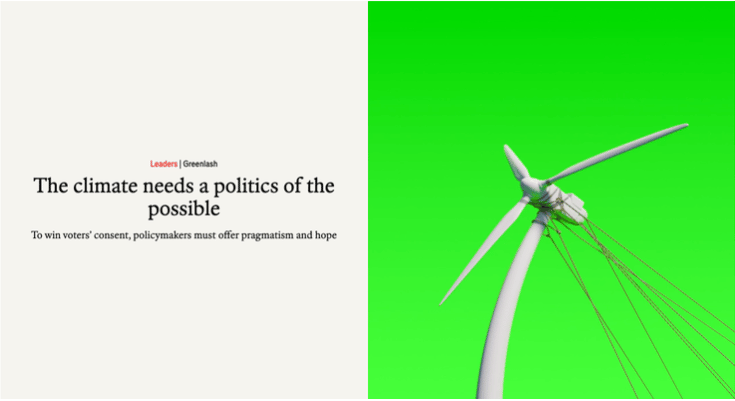
“Curbing climate change was never going to be easy. The fundamental energy balance of a planet cannot be changed overnight; nor can a fossil-fuel-based economy that serves billions of people be replaced without furious political objections. But today the problem looks particularly hard.” - starts the headlining Economist Leaders piece of the week.
The Net-Zero at All Costs narrative is being repositioned as un-workable because nobody is really willing (or able) to pay the all costs.
One could posit that this is because an honest discussion of the costs has not really taken place, and the expected returns that were supposed to easily cover these costs have not quite materialised. To make things harder, the attempts to find the responsible “wealthy parties” who will pick up the bill for themselves and for everyone else has proven to be a big challenge. And this leaves a widening gap between public narrative of the last decade, that relied on the idea of clean-green-and cheap new energy that will pay for itself, and realities of the achievable speed, financing, and complexity of the energy transition toward a deep enough cut in emissions.
A new narrative, as seen in the Economist, seems to be an attempt at repositioning Net-Zero, as a “guideline”, rather than a hard target, while still expecting to somehow reach it (some day). -- Can't help it but, notice a resemblance to some other doctrines with a promise of a bright future to arrive some day, only that day is always firmly implanted into the future, at any point in time.
"If a target is so hard that it cannot win consent, then it needs to be changed. But how? For rich countries to abandon stringent net-zero targets outright would demoralise greens, energise climate nihilists and make sensible reforms harder. Better to find ways to ease them into the “more of a guideline” category. There will be resistance from those who believe that all problems can be solved by “more political will”, but as a famously iron-willed German once said, politics is the art of the possible." - writes the Economist.
The positioning piece zooms in on the right dilemmas, which can be boiled down to the misaligned interests of different groups around the net-zero goal, but it then gets loses track with the conclusion, classifying the problem as one of politics and essentially calling for more spin to solve the very problems that excessive spin and opaque on the hard truths communications caused in the first place.
There is indeed a dire need for a new energy transition narrative, but it needs to be built on honesty and willingness to discuss the hard things with the public and all the stakeholders involved, in an effort to get to a shared vision of the best possible outcome for all. An achievable outcome, rather than a moving guidepost of a bright, illusory future.
Spin as hard as possible, and you still cannot replace the physical costs of the energy transition that someone will need to pay with the “art of the possible,” “stories that play well,” and “attractive ideas” in politics. For deep emissions reductions needed to get to net-zero, big sacrifices would be required, and realistically nobody wants to make them. And yet, the only feasible way to get this done is through transparency and genuine buy in.
It is undeniable that the energy crisis and the ever-increasing global political volatility have pushed the cost of the energy transition up and made it more challenging than it already was going to be, but they are not the sole reason of the apparent derailment in Net-Zero policy. They simply accelerated the inevitable outcome of half-true public narratives and highlighted a failure to align interests behind a concrete and clear common goal.
To those in the energy sector following the issue closely, the gap between public messaging and reality of the actual speed, financing, and complexity of the energy transition to dramatically slash emissions has been apparent.
The Economist article thoughtfully notes that: “reaching net zero in the nearish future would require emission cuts to be quick, deep—and painful. For countries which have not yet seen any decline in emissions—which, worldwide, is most of them—the steepest cuts would have to come very early. In many cases such scenarios are barely physically imaginable, let alone politically feasible.” It diagnoses the problems well, but prescribes the wrong medicine - the same one precisely that has shown not to work, because it is misleading and divisive .
It is absolutely true that "potent rallying calls" are better than "abstract targets," and that "(v)oters everywhere prefer cleanliness to pollution and a future in which they can thrive to one that looks dangerous." It is also true that voters everywhere prefer not to face financial hardship and not struggle with affordability of their basic needs, and if the choice falls there, expecting people to choose cleanliness is a failing strategy. That has been the reason behind growing opposition to climate action.
"The Art of the Possible" in the energy transition is not rhetorics and political rally calls. It is the space in the intersection of emissions cutting ambition and feasibility -- technological, economic, and social. Everything outside is not likely to succeed.
Ahead of COP30 in Brazil this November, which will mark the tenth anniversary of the Paris Agreement, less than a fifth of the countries submitted a new set of the required Nationally Determined Contributions (NDC’s). (see FT; Climate Action Tracker )
The world is at an inflection point, and it is perhaps time to have some straight talk, un-spun: No hiding behind big words, no blame dodgeball - just real honest dialogue about the tradeoffs, benefits, and the impact on the environment, and what can be done - really.
And to stay in the line of real talk - ten years in the perspective of energy systems is a very short timeline, so we did see a lot of rapid and highly impressive progress in the short period that the Paris Agreement has existed. This is a great thing. Ten years is also long enough to review the cost-benefit and sustainability of the policies, so as the momentum of the first decade's political slogans is slowing, let’s get real on targets and plans for hard but achievable things - no more spin.
Building Smarter Energy Communications
© 2026. All rights reserved.
Send us a message, or
Book a free discovery call, or send us an email.
contact@statem.net