
The Electrification Wager | Strategic Energy Briefing | July 13
Your weekly strategic energy briefing: the stories that shape global energy narrative in which you operate. Situational intelligence for oil, gas, and energy executives who want to lead their own narrative.
CONTEXTNEWS & NARRATIVEANALYSIS
The Electrification Wager
Subscribe and get the briefing in your inbox each week.
TL;DR
The European Commission publishes its Electrification Action Plan on Friday, July 17th; a leaked draft has been covered extensively.
The plan sets out to convert fossil fuel demand to electricity as a security, competitiveness and industrial imperative, with a 32% by 2030 electrification commitment already on the books and a binding target expected later this year. Industry is split: an alliance of electrification players wants binding targets, while energy-intensive industries want the plan judged on delivering €50/MWh industrial electricity instead.
I flag these blind spots for the European operators and governments to watch for in the final document, as they will determine whether this will help or harm Europe's competitiveness.
Demand creation does not guarantee domestic industry, and Europe's clean-tech base is thin (about 2% of manufacturing value added) while the existing industrial base erodes;
Technology mandates contradict the plan's own neutrality language;
Moving the "tax portion" off electricity bills shuffles costs without addressing their cause; and the €200 billion import-savings case comes without a visible cost-benefit assessment.
Meeting the target implies more than 460 GW of new firm capacity, while at least 120 GW of renewables already cannot connect due to grid constraints.
The main thing to watch on Friday: how much becomes binding instruments versus aspiration.
The Week's Context
Just as things seemed to be looking up in the Gulf, the ceasefire collapsed and Hormuz is closed again, while in Russia, Ukrainian attacks on fuel infrastructure intensified. The "temporary disruption" narrative is getting shaky in the fifth month of the confrontation. China has now banned helium export, Russia diesel. And as the push to substitute fossil fuels with electricity grows stronger in response, the IGU's LNG report showed record trade up 6.3% to 437 million tonnes in 2025, much of it absorbed by Europe replacing lost Russian pipeline volumes. Last year also had the highest LNG supply investment since 2019, so large new quantities of LNG are undoubtedly on their way, but where they go and at what price is less certain.
The re-escalating crisis will play strongly into the upcoming EU Electrification Action Plan (EAP). In this context, the IEA Executive Director said in an interview that Europe made a "major mistake" falling behind on electrification, with electricity's share in its final energy use around 23% for a decade. He made a comparison to China, Japan, and Korea (though not the neighbouring Norway, whose share is among the highest in the OECD at roughly 49%). This lines up with the incoming COP31 presidency's "35% by 2035" global electrification goal, announced in June, and the narrative has momentum.
I came to learn a lot about electricity when working in a government power networks policy division. That experience taught me about the risk that sits in the gap between directional policy documents and the 500-thousand-volt transmission line whose current the operator needs to reduce during a heatwave, because the heat makes it sag, and these are the kinds of nuances that need be accounted for when planning your system capacity. Closing that gap was my job.
The complexity in electricity, not just technical but in its many market designs and regulatory regimes, often deters deep public debate and creates blind spots. I see a number in the upcoming EAP.
The big picture and different views
"With decisive action at all levels, Europe can become the first electro-continent," the Commission says, promising investments, savings and benefits well beyond the energy system. The draft casts the shift as a socio-economic, competitiveness and security imperative rather than a climate one, and expects the new elctro demand to translate into European clean tech factories and qualified jobs.
The target number was not in the leaked document. Reporting suggests a binding number will follow later this year in the post-2030 energy package, but the Clean Industrial Deal already states 32% by 2030, so I will use that.
If a 40% increase in less than four years strikes you as ambitious, many industry voices will disagree: the Electrification Alliance (Eurelectric, WindEurope, SolarPower Europe, the heat pump and e-mobility associations, and others) calls for binding electrification targets, and Eurelectric's own modelling points to 50-70% by 2050. Agora supports an EU target provided it comes with national and sectoral granularity; Strategic Perspectives calls for a binding 50% by 2040; and over 100 companies with a combined $1.5 trillion in revenue have signed a call to make electrification a central pillar of industrial strategy.
Industry is not united, however: the Alliance of Energy Intensive Industries, the European Chemical Industry Council (Cefic) among them, opposes a percentage target altogether, arguing the plan should be judged on whether it delivers €50/MWh industrial electricity.
This is operationally consequential for everyone tied to Europe's energy system: suppliers, operators, financiers, consumers and industry at large.
With energy demand in Europe on an overall decline, particularly as industrial closures and relocations accelerate (see below), the increase in electricity's share comes not from connecting new customers but from converting existing demand to electric technologies, and building the generation, transmission and distribution assets to meet it. If successful, this also means volume loss for gas utilities already in a tough spot with reducing run times.
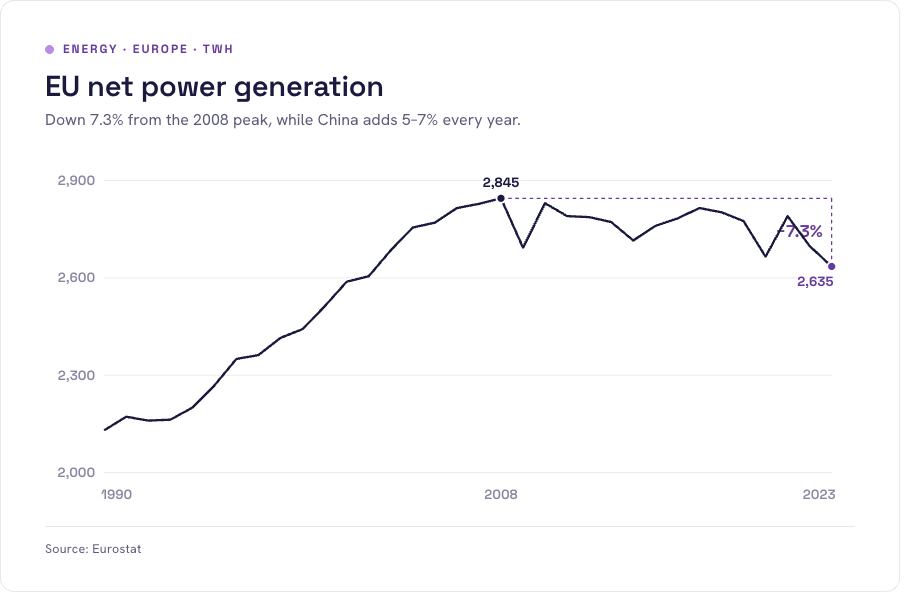
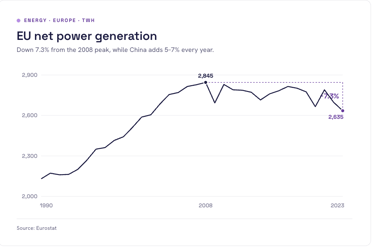
Today's European electricity system is about 1,162 GW (Eurelectric). Meeting the target would require more than 460 GW of new firm capacity, a directional illustration; the build exceeds demand to provide reliability reserve and cover intermittency. For scale of the challenge on the delivery side, let's take transmission: Ember reports at least 120 GW of proposed renewable projects unable to connect because of grid constraints, and almost 700 GW sitting in connection queues across the eight countries that report queue data.
What are the blind spot risks?
Crisis mode leads to reactive measures
The crisis context is the first blind spot: after two massive geopolitical energy shocks, Europe needs to act, and a reactive environment crowds out technical debate at the level an ambition this big needs.
Re-industrialisation and spurring domestic clean-tech industry
Local demand does not guarantee local industry, a lesson learnt in the Energiewende era. Demand creation grows deployment, but it does nothing for local supply chain competitiveness. Protective policies can try to force local content, but even setting trade rules aside, that significantly raises the costs. Low-cost renewable technologies exist because China manufactures them at scale and supplies cheaper than they would be if produced in Europe.
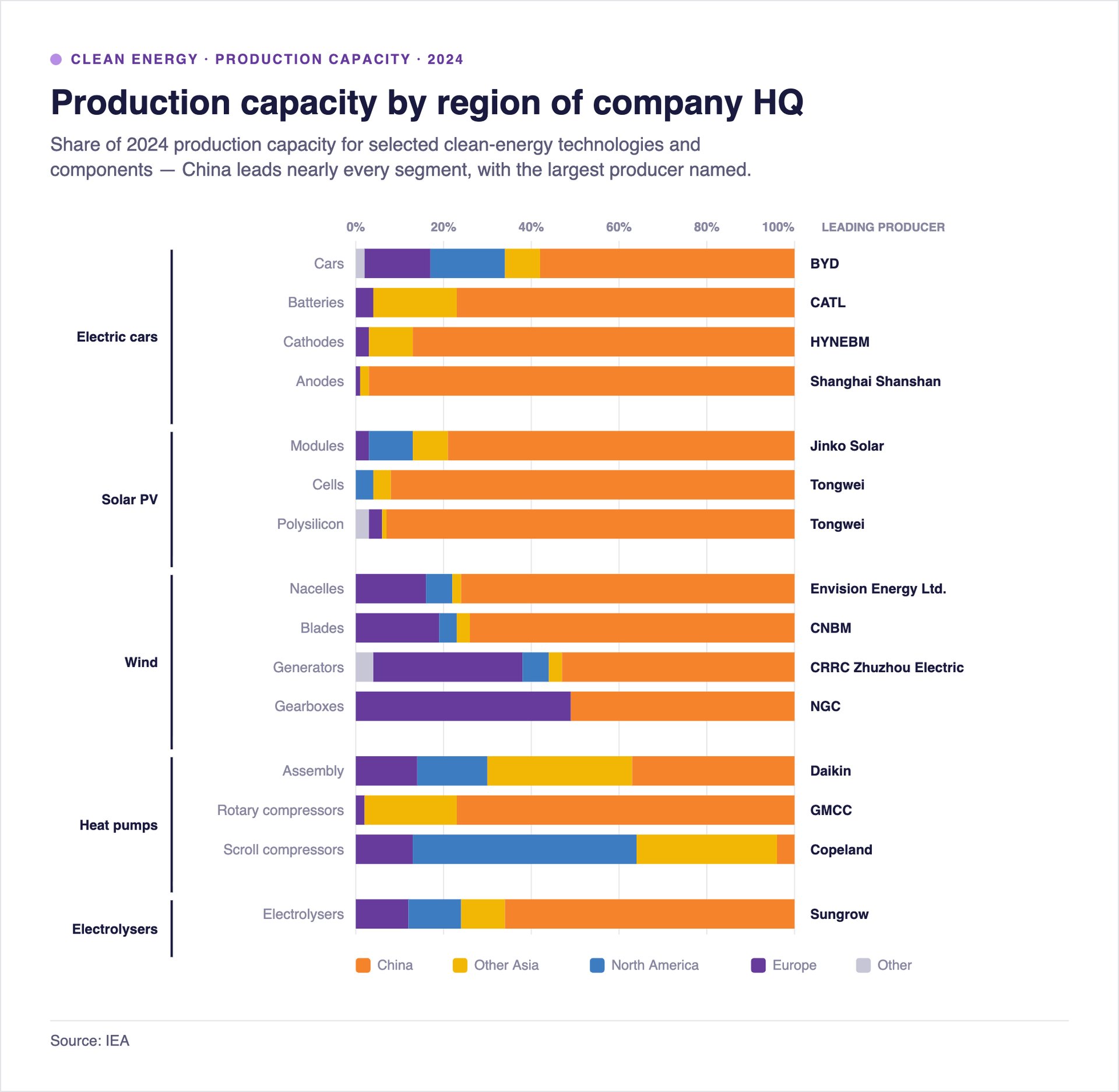
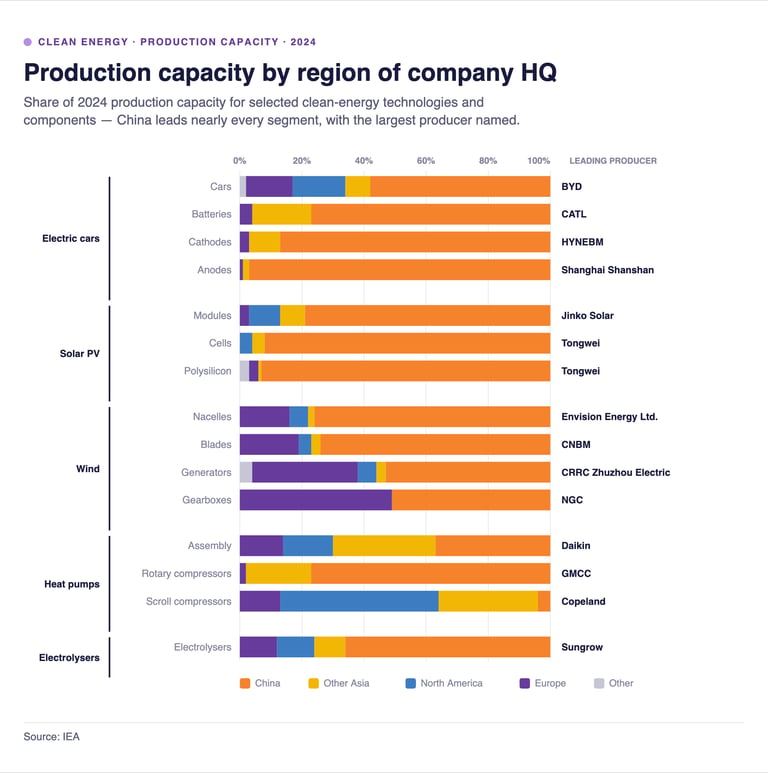
Meanwhile, Europe has been loosing its traditional industries, and clean-tech remains a small share of total manufacturing. EU statistics have no clean-tech category. The proxy I used, summing wind (ETIPWind), heat pumps (EHPA), grid and HVDC cable (company filings), batteries (Bruegel) and solar PV, puts it at roughly €40 to 50 billion in value added, about 2% of the EU's €2,470 billion manufacturing base (Eurostat GVA, 2023). The prominent strengths, wind and power system components, are respectively under Chinese price pressure and dependent on heavy industrial outputs upstream, which have been closing down in Europe. They are important, but the potential trade-off with energy-intensive segments is a risk that seems under-appreciated. Also, per the IEA, none of the largest companies or production facilities across key clean energy supply chain segments in 2024 is in Europe.
According to the European Commission's 2025 report on the competitiveness of clean energy technologies:
Wind: still highly competitive, but under growing Chinese price pressure. In 2024 the EU held close to 13% of global manufacturing capacity in blades and nacelles and about 22% in towers; EU companies had close to 90% of the European market but 23% of the global one in 2023, down around 7% from 2022.
Batteries: about 7% of global output, dependent on China for cathodes and anodes – both critical.
Heat pumps: EU manufacturers lead in high-end domestic and industrial solutions, and assembly capacity is on track for 2030 needs – but key components, like compressors, are imported.
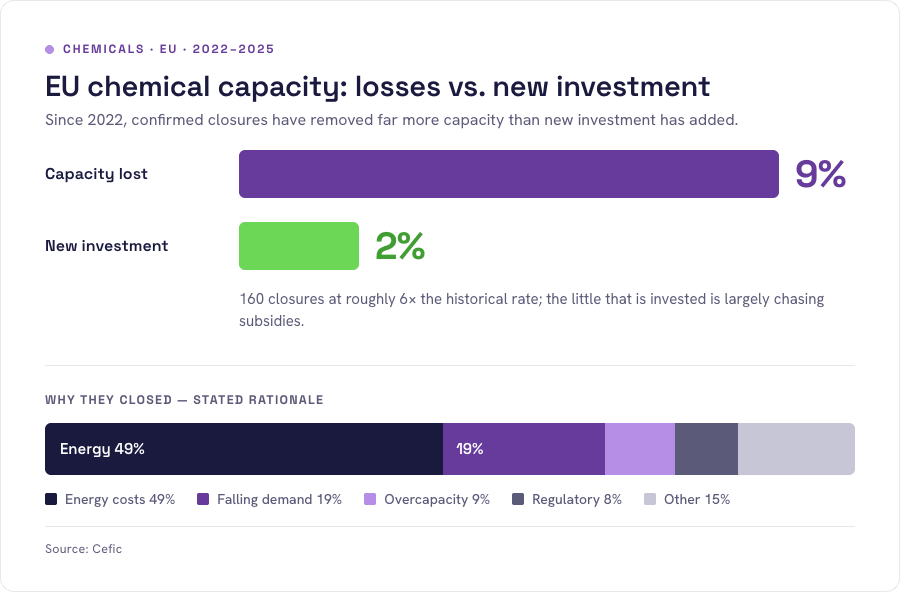
So the new base the plan wants to build on is thin, and the existing base continues to erode. CEFIC's chemicals sector closure radar counts 160 closures in 2022-2025, totalling about 9% of European capacity by volume, with the annual pace increasing sixfold, against roughly 2% of capacity in new investment, much of it in the clean tech space. Energy costs were cited as the primary reason in half the announcements.
The OECD reads the same way: chemicals the most affected sector, output down 10.3% between mid-2021 and mid-2024 to levels last seen in 2009, energy-intensive production down 12.4% and imports down 9.2% against 2021, and a trade balance in energy-intensive industries sliding toward deficit since 2012.
Neutral technology mandates
Despite an honourable mention of technological neutrality, which signals a recognition of the principle's importance, there are still technology-specific targets and mandates. Most are restated from previous EU policy documents, but some are new:
Battery storage capacity to be increased from 55 GW to 200 GW by 2030 (restated)
Vehicle-to-grid requirement by 2027 (new, and potentially significant)
Doubling the heat pump installations by 2030
50% of final consumers on smart meters by 2031 to unlock demand response
100 GW of additional renewables deployed per year (restated)
Lowering prices through the "tax portion of the bill" and ensuring that electricity isn't taxed above gas
Lowering prices through the "tax portion" of the bill
This is an area of market intervention: "futureproofing electricity bills" and mandating a minimum electricity-to-gas price ratio. How the "tax portion" gets defined will matter, because the "non-energy" parts of the bill vary widely between member states and cover very different things.
The logic goes: electricity is too expensive, often at 3x+ the price of gas, so lower its relative cost and the business case improves. But the preceding question is why electricity costs so much in the first place?
The non-energy component is what, in many cases, funds the existing system: operation, grid upgrades, reliability, and the incentives behind today's decarbonised power. If it moves off the bill, where does it go and who funds it? Shuffling the cost never addresses its cause.
Lowering prices through the avoided fossil fuel import bill
The driving idea is that accelerated electrification could replace around two-thirds of Europe's gas demand and halve oil consumption by 2040, cutting the fossil fuel import bill by some €200 billion. The leaked draft reportedly notes the EU spent an extra €50 billion on fossil imports during the first 111 days of the Gulf crisis alone. The cost side of the electrification equation is less specific. The plan rests on the proposition that it pays for itself, and benefits outweighing costs. Whether a cost-benefit assessment was done at EU level is not clear from the draft. If not, the case for one at national level is pressing.
These calculations are better run on paper, than learnt when the bill arrives.
The trouble with an assumed pay-for-itself logic is that someone still pays, and none of the stated measures is cheap. To get to 32% electrification by 2030 means to build 40% of Europe's entire electricity system in under 4 years, and I will leave it to the audience to let me know if they think this target setting is looking a little like a blind spot.
The wrap
The final document is out Friday, July 17th. The main thing to watch is how much turns into binding instruments vs aspiration. Impacted players have a window to assess their own exposure before the binding version arrives.
If you are looking to go deeper on positioning, let's chat.
Sources: IGU World LNG Report 2026 · Enerdata Yearbook · UNFCCC/COP31 Presidency (June 2026) · EUobserver (July 2026) · Clean Industrial Deal, COM(2025) 85 · Electrification Alliance (Nov 2025) · Eurelectric, Decarbonisation Speedways · Agora Energiewende (2026) · Strategic Perspectives (June 2026) · Alliance of Energy Intensive Industries (Feb 2026) · Ember, Crossed Wires (April 2026) · EC clean energy competitiveness report, COM(2025) 667 · IEA, Energy Technology Perspectives · Cefic/Roland Berger Closures Radar (Jan 2026) · OECD · Eurelectric electricity data · own estimates where indicated
Enhancing Energy Security
The security argument behind the plan is implicated in this industrial capacity too. According to the IEA, China controls 60-85% of the five key clean energy technology supply chains, a far higher concentration than in oil and gas or most other strategic products. Substituting imported molecules with domestically generated electrons still means substituting one import dependency for another, at the equipment layer.
Want to receive these directly?
Building Smarter Energy Communications
© 2026. All rights reserved.
Send us a message, or
Book a free discovery call, or send us an email.
contact@statem.net