
The Context and Narratives: Week in Focus Mar 16 - 22 | IRAN war and More
Catch up on the Iran war energy crisis timeline and everything that is shaping the context around the global energy narrative with this carefully curated review of key energy news #ICYMI. We create this synthesis from hundreds of read articles each week, so you can save time and get up to speed only on what matters - fast.
CONTEXT
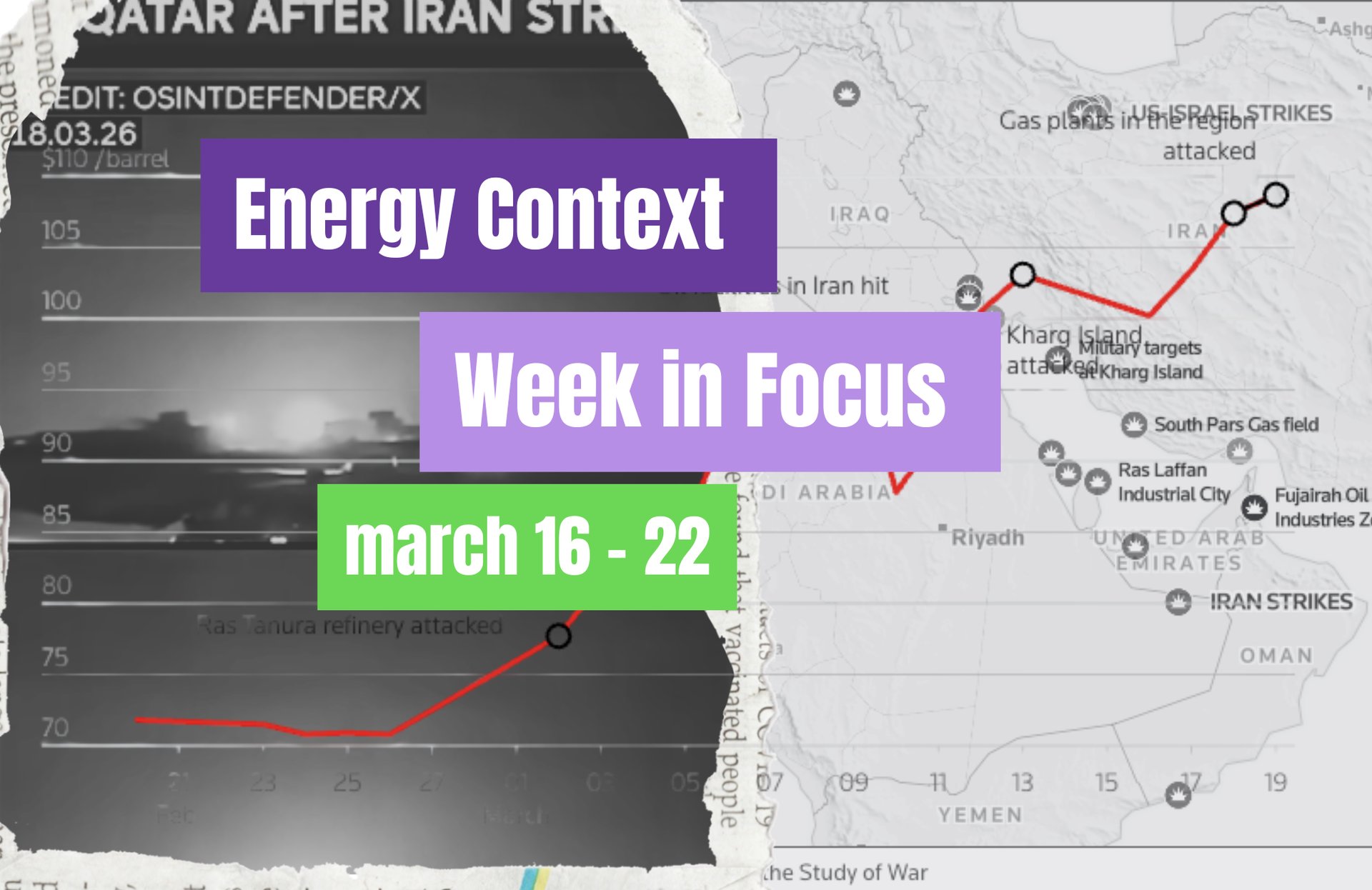
The Global Energy News and Context in Focus
#ICYMI
Your 16-minute briefing on everything that matters for the energy business context at the start of the week. We went through dozens of energy news stories and reviewed what matters, so you can be across it, fast.
Week of March 16 – March 22, 2026
Part 1: The War in Iran
Three weeks of the Iran war put it squarely into the worst global energy crisis inducing stage. This is an energy war, that crossed from trade disruption to permanent infrastructure destruction - energy facilities being the target.
On Monday, the first production attack set fire to the UAE's Shah. On March 18, Iranian missiles struck Qatar's Ras Laffan, the world's largest LNG facility, knocking out 17% of the country's export capacity for 3 to 5 years. Gas infrastructure is now a target of war, and a year of expected LNG oversupply has become a multi-year structural shortage.
In the same 24-hour period, Iran struck energy facilities across five Gulf states, hitting Saudi Arabia's SAMREF refinery at Yanbu (the kingdom's only functioning crude export route), Kuwait's two main refineries, and the UAE's Habshan gas complex. Iraq declared force majeure across all foreign-operated oilfields, cutting Basra production from 3.3 million bpd to 900,000, the largest single-country curtailment of the crisis. Physical oil prices disconnected from futures: Oman crude surged past $162/bbl and Murban above $145, while Brent futures hovered at ~$112, exposing the limits of US efforts to suppress headline prices. European gas prices have now doubled since the war began. The IEA called this the largest supply disruption in the history of the oil market and published its broadest demand-reduction recommendations since the 1970s, acknowledging that supply-side measures alone cannot close the gap. China banned fuel and fertiliser exports, fragmenting global product markets. Nations pivoted to coal as LNG became unaffordable, especially in Asia, but also in Europe. Airlines began drawing up contingency plans for physical jet fuel shortages within weeks. Iran signalled it will not accept a ceasefire without guarantees against future attacks, and its Foreign Minister called for "new arrangements" for Hormuz transit. By Sunday, Trump threatened to "obliterate" Iran's power plants if Hormuz is not reopened within 48 hours; Iran responded by threatening to destroy Gulf desalination and energy infrastructure, introducing civilian water supply as a target for the first time.
In Europe, coincidently, the Russian energy import measures begin to take effect, with steps to end short-term supplies first - Europe sources about 13% of its gas from Russia.
In the battle of narratives, this reopened the debate about fossil fuels versus renewables - more on this in Part 2.
Read our review to understand the underlying currents of this week's biggest energy context and how to position your organisation effectively within these rapidly evolving market dynamics. If you want to delve deeper into any of these topics or order a rapid research brief, we would be delighted to connect on a brief call. You can book directly through the button at the top of this page.
Iran War & Hormuz Crisis Timeline
Monday, March 16
Iran escalated from shipping attacks to direct strikes on upstream production, setting the UAE’s Shah gas field ablaze (1.28 bcf/d capacity, ~5% of global sulphur output) and hitting Iraq’s Majnoon field and UAE's Fujairah port. Downstream, Japan’s naphtha shortage forced six of 12 ethylene plants to cut output, and Australia, despite being the world’s top coal and LNG exporter, revealed it has only one month’s supply of diesel and jet fuel in emergency storage. Beyond energy, Taiwan’s semiconductor sector flagged converging supply risks from the conflict: 37% of its LNG from the Middle East with only ~11 days’ reserves, and one-third of global helium, critical for chip fabrication, processed in Qatar.
Drone Strike Sets UAE Natural Gas Field Ablaze, Abu Dhabi Says (Bloomberg)
Iran War Chokepoints Begin to Cast Doubt on Global Chip Supply (Bloomberg)
Shortage of Naphtha Threatens Supply Chain Chaos in Japan (Bloomberg)
Even Major Energy Exporter Australia Is Vulnerable to Iran War (Bloomberg)
Tuesday, March 17
The crisis hit consumers directly: US diesel topped $5/gallon for the first time since 2022, and Goldman Sachs warned the shock is structurally a refined products crisis, not a crude one, because ~60% of lost Gulf crude is the heavy, sour grade essential for diesel, jet fuel, and fuel oil. Trump’s push for allied naval escorts to reopen Hormuz was rejected by the UK, France, Japan, and others. Asia’s pivot to coal accelerated as Wood Mackenzie slashed its 2026 Asian LNG import growth forecast from 12.4 mt to ~5 mt. The US moved to ease Venezuela oil sanctions for marginal supply relief.
Trump’s Push to Reopen Hormuz Looks Unlikely Without a Ceasefire (Bloomberg)
US Diesel Tops $5 a Gallon as War Disrupts Fuel Supply Chains (Bloomberg) ·
Goldman Says Oil’s Biggest Shock to Hurt Refined Products Most (Bloomberg)
Asia pivots to coal as Middle East conflict chokes LNG supply (Reuters)
US to Ease Venezuela Sanctions to Unlock More Oil Amid Iran War (Bloomberg)
Wednesday, March 18
The war’s most consequential day. Israel struck Iran’s South Pars gas field; Iran retaliated with ballistic missiles on Qatar’s Ras Laffan, the world’s largest LNG complex, causing “extensive damage” and destroying Shell’s $18bn Pearl GTL plant. In the same 24-hour window, Iran hit Saudi Arabia’s SAMREF refinery at Yanbu, Kuwait’s two main refineries, and the UAE’s Habshan gas complex (6.1 bcf/d). Shipping data revealed Iran controls Hormuz selectively: its own exports run at ~1.2 mb/d while all other Gulf producers combined manage only ~400,000 b/d, a 98% drop. Container shipping descended into chaos with 3,200 vessels trapped in the Gulf and rates quadrupling. Qatar offloaded its April LNG slots at Zeebrugge, signalling no resumption of shipments.
Iran inflicts ‘extensive damage’ on site of world’s largest LNG facility in Qatar (FT)
Iran targets energy facilities across Gulf after Israel struck its key gas installations (Reuters)
Oil and Gas Prices Surge as Iran Attacks Major LNG Plant (Bloomberg)
Iran still seen capable of escalating attacks on Gulf’s energy (FT)
Iran Moves Its Own Oil Through Hormuz as It Chokes Other Traffic (Bloomberg)
Iran conflict turns shipping market into ‘wild west’ (FT)
The attacked South Pars natural gas field is an energy lifeline for Iran (AP News)
European Consumers Seek Out Solar, EVs as Energy Prices Surge (Bloomberg)
Qatar offloads five LNG slots at Belgium’s Zeebrugge terminal for April, sources say (Reuters)
Thursday, March 19
QatarEnergy CEO Saad al-Kaabi confirmed the full damage: 17% of Qatar’s LNG capacity (12.8 mt/yr from two of 14 trains) will be offline for 3 to 5 years, costing $20bn/yr in lost revenue. Force majeure declared on long-term contracts with Italy, Belgium, South Korea, and China. Analysts called it the “Armageddon scenario” for gas markets. European gas prices surged 35% in a single session, and the ECB warned of “material” inflation impact. Israel reversed course, committing to no further energy infrastructure strikes after Trump’s rebuke, while the Pentagon requested $200bn from Congress for the war. Six governments (UK, France, Germany, Italy, Japan, Netherlands) called for a moratorium on energy facility strikes. Iran signalled it will only stop fighting in exchange for guarantees against future attacks plus sanctions relief. Europe’s internal energy divide sharpened: electricity prices in Italy, Hungary, and Romania climbed 12%+ YTD while Spain and Portugal saw prices fall 46%.
‘Armageddon scenario’ for gas markets as Qatar hit by missiles (FT) · Exclusive: Iran attacks wipe out 17% of Qatar’s LNG capacity for up to five years, QatarEnergy CEO says (Reuters) · Gas Traders Weigh Attacks at World’s Largest LNG Plant in Qatar (Bloomberg)
Iran Defies Trump With Energy Strikes As War Costs Rise (Bloomberg) · Natural gas prices soar as Iran, Israel strike Middle East energy infrastructure (Reuters)
Iran sets its price to end the war (FT)
Europe needs to prepare now for an extended energy shock (FT)
Iran war leaves deep, costly scar on Mideast energy (Reuters)
Panicked Indians are scrambling to buy gas (The Economist)
Asia Buys Most US Oil in Three Years as War Blocks Mideast Flows (Bloomberg)
The Iran war is forcing Europe to confront its energy problem (The Economist)
Europe Boosts Coal-Fired Power as Gas Prices Rally on Iran War (Bloomberg)
Iran war fallout lands hardest on Europe’s most gas-dependent nations (Reuters)
Italy, Belgium set to lose gas supply after world’s biggest LNG plant bombed (Politico EU)
Gulf states request urgent debate at UN Human Rights Council, documents show (Reuters)
Friday, March 20
The Kremlin called the EU’s Russian gas phase-out “self-defeating” and said Russia would redirect remaining volumes to other markets. Iraq declared force majeure on all foreign-operated oilfields - the biggest single-country production curtailment of the crisis, cutting Basra from 3.3 mb/d to 900,000. The IEA published its broadest demand-reduction plan since the 1970s, acknowledging that existing supply-side measures including emergency reserve releases “cannot fully offset the scale of the disruption.” Physical oil prices disconnected sharply from futures: Oman crude topped $162/bbl and Murban exceeded $145, while Brent futures sat at ~$112. China banned fuel and fertiliser exports. Airlines drew up contingency plans over jet fuel shortages as NW European jet fuel hit a record $1,730/tonne.
Exclusive: Iraq declares force majeure on foreign-operated oilfields over Hormuz disruption, sources say (Reuters)
IEA: New IEA report highlights options to ease oil price pressures on consumers (IEA)
Qatar’s gas empire comes under fire (FT)
China cracks down on fuel and fertiliser exports (FT)
The perils of the Hormuz escort plan (FT)
Oil Refiners Pay Huge Premiums to Replace Middle East Crude (Bloomberg) ·
The Oil Prices You See Don’t Tell the Market’s Real Story (Bloomberg)
Asia Turns to Coal as Iran War Rapidly Shrinks Supplies of Gas (Bloomberg)
Airlines draw up contingency plans over jet fuel shortage fears (FT)
India’s Gas Utilities Aim to Grow Market Share on LPG Shortages (Bloomberg)
Kremlin says EU’s LNG plan is self-defeating, Russia will find new markets (Reuters)
Maritime security is key to global energy supplies (FT)
How the oil shock might spread (FT)
Could the US really release more of its strategic oil reserves? (FT)
Saturday, March 21
The EU asked members to lower gas storage targets to 80% (from 90%) and extended the filling deadline, acknowledging that a mandatory scramble to fill would spike prices further. Three weeks in, the war is escalating beyond Trump’s control: allied navies refused his escort request, White House aides are reportedly urging an “off-ramp,” and the Pentagon deployed additional Marines despite Trump’s promise of a “short excursion.” Urea fertiliser prices rose 30–40%, and the FAO warned global food supplies face disruption within weeks as factories across South and Southeast Asia halted.
EU member states urged to lower gas storage targets due to Iran war (FT)
Three weeks in, Iran war escalates beyond Trump’s control (Reuters)
Iran war’s energy impact forces world to pay up, cut consumption (Reuters)
Sunday, March 22
The world faces a gas supply “cliff edge” as the last pre-war LNG cargoes from the Gulf arrive within 10 days. Pakistan’s LNG terminals will cease operations by month-end. The Economist modelled that even an immediate ceasefire would leave markets undersupplied for four months. Trump threatened to “obliterate” Iran’s power plants within 48 hours; Iran responded that Hormuz would be “completely closed” until destroyed infrastructure is rebuilt, and threatened Gulf desalination plants - raising the prospect of water supply disruption for the first time. US oil and gas dealmaking froze as volatile prices made transaction pricing impossible.
World faces gas supply cliff edge as Gulf’s final LNG shipments approach ports (FT)
Even the best-case scenario for energy markets is disastrous (The Economist)
Iran threatens to retaliate against Gulf energy and water after Trump ultimatum (Reuters)
Iran war leaves US oil and gas dealmaking ‘in paralysis’ (FT)
Part 2: Key Energy Context Beyond the Gulf
Policy, Regulation, and Compliance
While governments brace for another energy crisis, firms are leaving major energy savings on the table
OECD · Mar 17, 2026
#IndustrialEnergyEfficiency
OECD research finds a 20x gap in energy productivity between top and bottom firms in the same industry. Raising the bottom quarter to the 25th percentile would cut industrial energy use by 42% with no output loss. Large firms underperform because scale gives them negotiating power on energy prices — the crisis sharpens the choice between subsidising cheap energy and using price signals to close the gap.
Spain warns EU against suspending carbon market to try to lower energy prices
Financial Times · Mar 17, 2026
#ETSDefence
Spain’s energy minister called ETS suspension proposals “irresponsible and a big error.” Spain’s 57% renewable electricity mix insulates it from gas pass-through. Von der Leyen will use the Market Stability Reserve to “keep prices in check.” Italy wants suspension, Germany questioned it (triggering a 7% carbon price drop), Spain plus seven others defend it — the likely compromise extends free industrial allocation beyond 2034.
https://www.ft.com/content/2fc4615a-c9bb-4b9e-be29-2c9c6ec44b5f
Silver linings to the heavy cloud of higher energy prices
Financial Times · Mar 18, 2026
#EuropeResilience
EU gas consumption is down 16% from the 2017–21 average. UK Energy Research Centre estimates gas will set the electricity price 60% of the time within three years (down from 90%). The 2022 windfall taxes remain in place. Europe is collectively stronger than 2022, but the argument assumes the Strait does not remain persistently blocked.
https://www.ft.com/content/f44ae39b-1e73-406e-9e12-c9045dedf0cb
EU ban on Russian gas, LNG spot imports begins
S&P Global · Mar 18, 2026
#RussianGasBan
The EU spot import ban on Russian gas and LNG entered into force March 18, with further restrictions through 2027. Physical flows through the Turkey-Bulgaria Strandzha interconnections fell 46 GWh/d. The ban creates a pincer effect: Qatar’s structural capacity loss tightens LNG for years while the Russian phase-out removes ~13% of EU imports on a legislated timeline.
Commission publishes updated guidance on REPowerEU Gas Regulation
European Commission · Mar 18, 2026
#REPowerEUGuidance
The Commission updated REPowerEU guidance to speed non-Russian gas import approvals while activating the Russian gas phase-out. The dual signal encapsulates Europe’s supply dilemma: tightening restrictions on Russia (~13% of imports) at the exact moment Qatar (~9%) has suffered structural capacity loss.
Secret EU-US talks to ease LNG standards failed to meet transparency
Euronews · Mar 19, 2026
#EUMethaneRegulation
Internal documents reveal DG ENER held undisclosed meetings with US LNG producers about potential amendments to the EU Methane Regulation. The Commission is “open to amending” the rules after 2028 reporting. At least two meetings were not registered as required. The tension between public methane regulation commitments and private flexibility signals to US suppliers matters because the US could supply ~40% of EU gas and LNG by 2030.
Key Energy Conferences
Iran war looms over global energy summit (CERAWeek)
Axios · Mar 19, 2026
#CERAWeek
Daniel Yergin said the Iran war “has been brewing for 47 years” and the nightmare scenario is it persisting “for more than weeks.” CERAWeek (Mar 23–27) will feature Energy Secretary Chris Wright, ADNOC CEO Sultan Al Jaber, and former Defense Secretary Mattis. Yergin predicts “a recasting of renewable energy in terms of energy security instead of climate” — a framing shift at the industry’s biggest event.
https://www.axios.com/2026/03/19/iran-war-gas-prices-global-energy-summit
Gas & LNG
Shell says global LNG demand to rise at least 54% by 2040
Reuters · Mar 16, 2026
#ShellLNGOutlook
Shell narrowed its 2040 LNG demand forecast to 650–710 mt/yr (54–68% above 2025’s 422 mt), with Asia accounting for 70% of growth. Shell acknowledged numbers were “not final, given the Iran war.” Climate activist investor ACCR had won 21% support for a resolution questioning Shell’s demand assumptions. The report’s publication on the day the war entered its third week highlights the tension: Shell projects decades of LNG demand growth while the world’s largest LNG facility lies damaged.
Explainer: Where does the EU get its gas and how is it impacted by the Iran conflict?
Reuters · Mar 19, 2026
#EUGasSupply
Qatar supplies ~9% of EU LNG, but the knock-on effect of Asian buyers competing for spot cargoes drives up prices for all imports. Norway (one-third of EU gas) confirmed no spare capacity; the US (25% of EU LNG) is at near-full capacity. TTF hit €74/MWh on March 19 — highest since January 2023, but still well below the 2022 crisis peak of €300+. Europe’s direct Qatari exposure understates the risk because the global competition for replacement cargoes reprices the entire market.
TC Energy could be open to return to B.C. LNG pipeline project as global gas crunch threatens
Financial Post · Mar 20, 2026
#CanadaLNGInfrastructure
Canada's TC Energy’s CEO said the company could re-enter the Prince Rupert Gas Transmission pipeline project (supplying Ksi Lisims LNG), with LNG Canada shipments to Asia surging in March. Both LNG Canada Phase 2 and Ksi Lisims have been referred to Ottawa’s major projects office. The crisis is prompting Asian buyers to ask whether continued dependence on volatile Gulf supply is sustainable, improving the odds for Canadian west-coast LNG infrastructure.
Oil
Move to unblock Nigeria’s oil sector hints at progress | How a vast refinery could mend Nigeria’s relationship with oil
Financial Times · Mar 18, 2026
#NigeriaOilRevival
President Tinubu resolved the OPL 245 dispute, Nigerian oil production rose to 1.5 mb/d in 2025 (up 8%), and the country attracted $5.3bn in upstream investment last year, which is equal to the previous eight years combined. At the same time, the $20bn Dangote refinery (650,000 b/d) is reducing fuel import dependency, with fuel imports down 23% in 2024. A meaningful shift in Nigeria’s investment climate at a moment when the world is competing for non-Gulf barrels.
https://www.ft.com/content/a51c010c-8086-46a0-929f-339636f21e57
Canada’s oil producers in line for C$90bn windfall from Iran war
Financial Times · Mar 21, 2026
#CanadaOilWindfall
Enverus estimates C$25–30bn in extra revenue per $10 oil price rise for Canadian producers. WTI surged from $67 to ~$98 since the war began. Production hit a record 5.19 mb/d and China sales quadrupled via the Trans Mountain Expansion. The crisis strengthens the case for Canadian pipeline infrastructure to Asia, but RBC warns sustained $100+ oil could push Canadian inflation to 3% and US inflation to 3.5%.
https://www.ft.com/content/81fa6ad2-7971-4177-9230-5cdb96e91004
Electricity
What the world can learn from Ireland’s battle to power data centres
Financial Times · Mar 17, 2026
#DataCentrePower #AIEnergy
Ireland’s data centres consume over a fifth of the country’s electricity (rising to nearly a third by 2034). New projects must source 80% of power from additional Irish renewables within six years. Europe’s first off-grid data centre microgrid launched in Dublin. A model other constrained markets are watching as AI demand outstrips grid capacity globally.
https://www.ft.com/content/9e949463-e394-46c9-b72f-65665b2c70b1
Renewables Cushion Europe’s Power Prices From Iran Shock
Bloomberg · Mar 17, 2026
#RenewablesRescue
Europe’s expanded renewable fleet means electricity prices are more often set by solar and wind rather than gas. Rabobank estimates prices would be ~one-third higher without the cushion. France’s nuclear fleet is also on stronger footing than in 2022. The seasonal advantage fades by winter however, and Uniper warns “sensitivity increases again toward the colder months.”
RWE Was Short European Gas Before Biggest Rally in Years
Bloomberg · Mar 20, 2026
#RWETradingLoss
RWE’s trading division was positioned for declining gas prices and expects a “weak” Q1 profit; hedge funds Millennium and Balyasny also suffered losses as gas futures doubled. Germany is now more likely to place lignite plants into reserve rather than close them by 2030 — the war is reviving the commercial case for coal assets scheduled for phase-out.
Wind and solar generated a record 17% of U.S. electricity in 2025
EIA · Mar 22, 2026
#USRenewables
US wind and utility-scale solar reached 760,000 GWh (17% of net generation), with solar up 34% YoY. Including small-scale solar, the share rises to 19%. But dispatchable sources (gas, coal, nuclear) still accounted for 75% of generation.
https://www.eia.gov/todayinenergy/detail.php
Environment, Emissions, ESG
Oil, Gas Majors Cut Green Spending for First Time Since 2017
Bloomberg · Mar 18, 2026
#GreenSpendingCut
Low-carbon investment by oil and gas majors fell by more than a third in 2025 to $25.7bn (6.5% of total capex, down from ~10% in 2024), the first annual decline in eight years. The Americas recorded the biggest contraction under Trump-era policy volatility. Only Repsol and Saudi Aramco increased spending (~$4bn each), suggesting the transition investment case is narrowing to national oil companies and European holdouts.
Senator Launches Investigation Into Methane Pollution in the Permian Basin
Inside Climate News · Mar 19, 2026
#Permian #MethaneEmissions
Senator Whitehouse (D-RI) launched an investigation after MethaneSAT found Permian Basin emissions were four times higher than EPA estimates (2.4% of marketed gas vs industry targets of 0.2%). Eight producers questioned including EOG, ConocoPhillips, Occidental, ExxonMobil, Diamondback, Devon, Chevron, and Mewbourne. The timing — during a war that has spiked gas prices and made methane a more valuable commodity — adds economic weight to the environmental argument.
BlackRock removes fossil fuel loophole from $2bn ESG bond ETF
ETF Stream · Mar 18, 2026
#ESGBondRules
BlackRock will apply fossil fuel business activity screens across all bonds including green bonds in its €1.9bn SEAG ETF, closing a loophole that allowed green-labelled debt from fossil fuel issuers. Ironic timing: BlackRock recently loosened ESG exclusion rules elsewhere, reflecting the tension between product integrity and fossil fuel sector returns.
https://www.etfstream.com/articles/blackrock-removes-fossil-fuel-loophole-from-usd2bn-esg-bond-etf
Broader Economy Risks
Patient(s) Zero
Prof G Media (Scott Galloway) · Mar 20, 2026
#EmergingMarketContagion
Galloway argues the real risk is not the headline oil spike ($127/bbl, VIX at 42) but sovereign debt contagion in emerging economies — Egypt ($5–8bn in bond sell-offs, pound down 11%), Pakistan (external debt at 315% of export revenue), Sri Lanka, and Bangladesh (95% energy import dependent). HSBC and Standard Chartered are the most exposed European banks, and the systemic threat lies in derivatives nobody stress-tested for $110+ oil.
https://www.profgmedia.com/p/patients-zero
Supply Chains
US fertiliser bosses cash in as Iran war boosts shares
Financial Times · Mar 21, 2026
#USGasArbitrage
CF Industries insiders sold $33.4mn in stock (shares up 25%) as the US-Asia gas price gap widened to $3/MMBtu vs $22 JKM. CVR Partners up 23%, LyondellBasell up 26%. ~9% of global plastic flows disrupted by Hormuz. The structural advantage of US ethane-fed production over Asian naphtha-based competitors is transferring value at a pace already triggering antitrust litigation.
https://www.ft.com/content/3dedd998-228e-4a24-b813-df324b4a25fa
Global carmakers retreat en masse from electric vehicle plans
Financial Times · Mar 22, 2026
#EVRetreat
At least 12 carmakers including Honda ($16bn in losses), Mercedes-Benz, Ford, Rolls-Royce, Bentley, Lamborghini, Audi, and Porsche are scaling back EV targets. FT calculates $75bn+ in cancelled EV launches and investments in the past year. The retreat reflects weak demand, eliminated US tax credits, weakened EU targets, and an energy crisis reinforcing the perception that the transition timeline was overstated.
https://www.ft.com/content/1198863d-4974-4c4d-be5f-9e7152045b26
Public Opinion & Reputation
Iran war should trigger faster exit from fossil fuel dependence, UN climate chief says · UN Climate Chief in Brussels: fossil fuel dependency is ripping away national security and sovereignty, but renewables turn the tables
Reuters · Mar 16 / UNFCCC · Mar 17, 2026
#FossilFuelDependenceDebate
UNFCCC Executive Secretary Stiell called the crisis an “abject lesson,” said Europe’s fossil fuel imports cost €420bn in 2024, and labelled proposals to slow the transition “completely delusional.” The political contest this frames — Italy and Hungary pushing for climate rollback vs the Commission’s argument that dependence is the vulnerability — will shape EU energy policy through the summer.
Gas will not be killed off by renewables any time soon
The Economist · Mar 19, 2026
#GasBridgeFuelDebate
Even in a 90/10 clean/fossil grid, for roughly a tenth of the time nearly all power comes from gas. Batteries smooth short-term fluctuations but can’t cover longer gaps. Spain (gas sets prices 15% of the time) shows what’s possible, and Pakistan’s solar jump from 0.7% to 10% is saving an estimated $6bn in LNG costs this year. Gas import infrastructure must be maintained even as renewables scale, and as demand falls, supply may concentrate among fewer producers, making markets thinner and more volatile.
https://www.economist.com/leaders/2026/03/19/gas-will-not-be-killed-off-by-renewables-any-time-soon
Activism & Legal Battles
Oil majors shifting from greenwashing to fossil fuel advocacy, advertising study finds
Eco-Business · Mar 18, 2026
#FossilFuelAdvocacy
Clean Creatives analysed 1,859 campaigns by Shell, ExxonMobil, BP, and Chevron (2020–2024), finding a shift from climate leadership to explicit fossil fuel dependence advocacy. Asian campaigns focused on family values and brand loyalty rather than climate or security. The Iran crisis simultaneously validates the “fossil fuels are essential” narrative and undermines it by demonstrating that dependence is the vulnerability.
Sources: Financial Times, Reuters, Bloomberg, The Economist, AP News, Politico EU, Axios, S&P Global, IEA, EIA, OECD, European Commission, UNFCCC, Euronews, Inside Climate News, Financial Post, ETF Stream, Eco-Business, Prof G Media
Want to receive contexts directly in your inbox ?
Building Smarter Energy Communications
© 2026. All rights reserved.
Send us a message, or
Book a free discovery call, or send us an email.
contact@statem.net