
Oil and Gas Reputational Risk and the Real Lesson from Hormuz
The dominant public narrative on this topic so far has been about dependency, and that, naturally, is not a good look for a business that seeks a successful long-term relationship with its customers, nor is being on the other side of it a good position for the customers — nobody likes to feel like they are on the hook, and nobody wants to be the hook merchant.
NEWS & NARRATIVE
The oil and gas reputational challenge. The real lesson of Hormuz is about interdependence.
Subscribe and get the briefing in your inbox each week.
Aside from bringing the obvious havoc to operations and industrial supply chains, cutting off essential supplies of oil, gas, and their derivative products, the Hormuz crisis poses a reputational challenge to oil and gas, which we see showing up in the more frequent denouncements of fossil fuel dependency in political speeches and policy announcements to pour more money into faster electrification. With the second major geopolitical crisis disrupting supply in four years, that is hardly surprising, but is this the right framing, and is there a bigger story behind raw material and fuel security of supply?
The dominant public narrative on this topic so far has been about dependency, and that, naturally, is not a good look for a business that seeks a successful long-term relationship with its customers, nor is being on the other side of it a good position for the customers — nobody likes to feel like they are on the hook, and nobody wants to be the hook merchant.
The reality is not this binary however, and this is where I think it is important to challenge the habitual frame once in a while, even if only to ensure that it still serves us right.
I'd argue there is a bigger story that the Hormuz disruption is telling us, and it might suggest that the dependency framing deserves a second look. The Hormuz crisis impact story is equally about visibility into what the energy and industrial sectors make possible in society, what they mean in everyday life, and how invisible that link can be until there is a tear in it.
We live in an incredibly complex world of production and consumption, which can be seen as one big chain of dependencies. Alternatively, we can also frame it as an interdependent ecosystem that humanity has created for itself. The difference between the two frames is agency. Dependency takes it away, creating an environment for reactive panicked responses, which may or may not in fact help solve the issue at hand. Interdependency, conversely, restores agency to all parties and provides ground for better systemic solutions where everyone takes accountability for their part.
The challenge with choosing the interdependency frame is that its existence is largely invisible to the public. Thanks to the neatly designed and carefully engineered technologies, processes, and seamlessly connected global supply chains, the physical reality of what is behind our comfortably organised and full of utility lives, became all but mystical to most of us.
One doesn't usually need to think about how their hot water got into the tap, the detergent into the bottle, the rubber into the soles of our sneakers, or what stuff goes into smart phones, renewable energy, power grids, and microchips for computers and data centres.
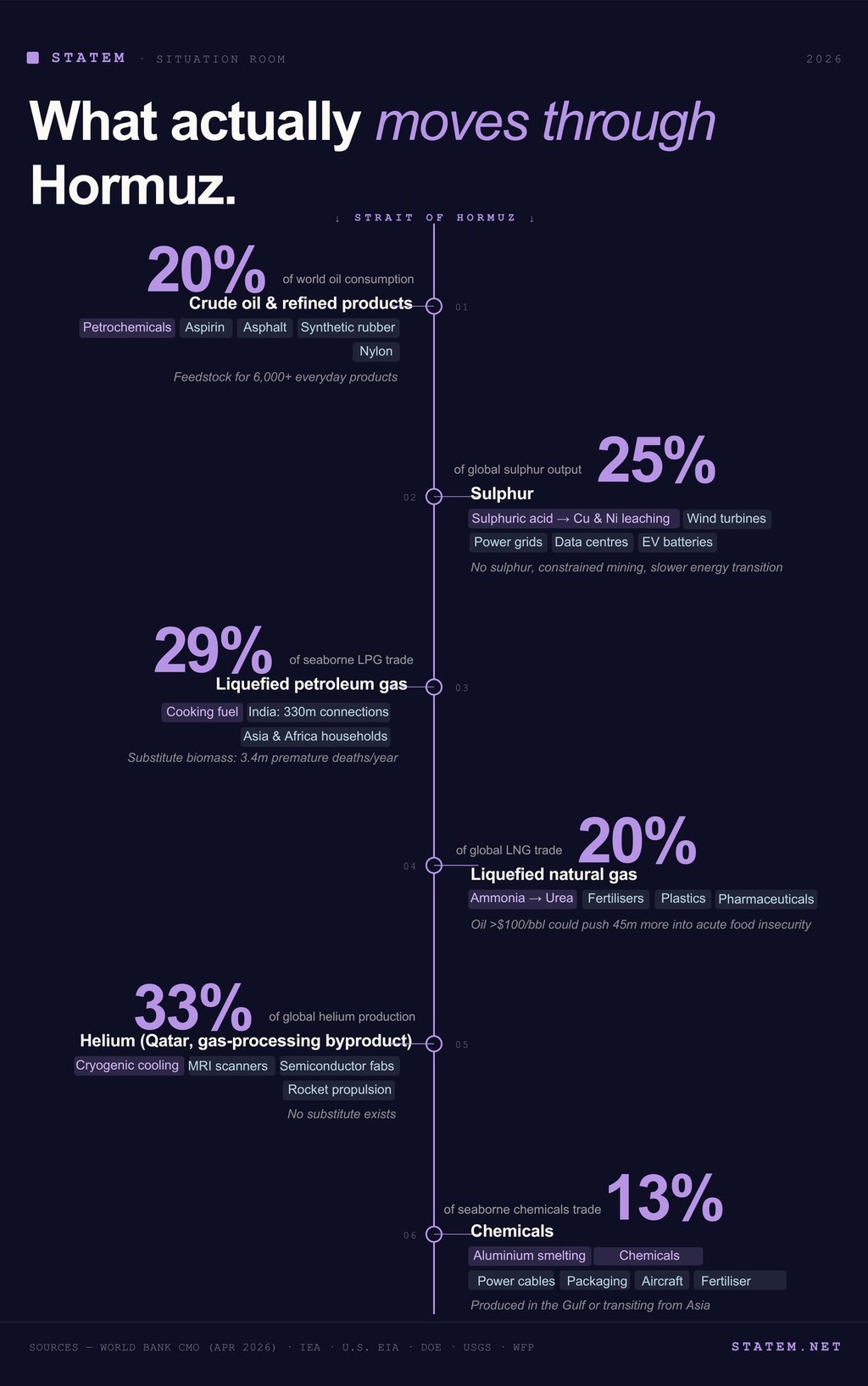
A huge amount of that stuff is made with raw materials that were conveniently out of sight and transited via the Strait of Hormuz. Take the disruption of sulphur, 25% of which globally is produced by the Gulf countries as a byproduct of oil refining and natural gas processing, and is used to make sulphuric acid, which is needed to leach copper and nickel from ore, which in turn are the material backbone of wind turbines, EV batteries, electrical grid infrastructure, and data centres. No sulphur, no sulphuric acid; no sulphuric acid, constrained copper and nickel mining; constrained mining, slower energy transition. The recent World Bank Commodity Markets Outlook report flags this explicitly as a risk that could "challenge the mining of metals globally" if the disruption persists. Or take helium, essential for cooling the superconducting magnets in MRI scanners, for semiconductor chip fabrication, and for rocket propulsion systems, a third of which comes from Qatar, produced as a byproduct of natural gas processing.
Only when something unexpectedly goes wrong in that chain, and the usually invisible global supply system glitches, as it has with the Strait of Hormuz closure, we suddenly become a little more aware of it, and this is where the choice of frame and the messages we adopt in response matters a lot.
For the companies that produce, process, and move the raw materials that make the modern world modern, this is a choice of some obvious importance. But I'd argue that it is just as important for the society as a whole to establish a better dialogue with everyone who makes things we use every day work as they do, seamlessly, so we don't even need to know how they got to us, unless we want to.
Choosing to look at this through an interdependency lens will help address vulnerabilities and mitigate future risk more cost-effectively. For the suppliers, it will enable a return to the value proposition from an exhausting defensive argument about the need to exist, and for the consumers, it will provide the space to negotiate what is truly important to them in their products — including security, affordability, and environmental considerations.
This isn't to say that innovation in supply chains and feedstocks should stop evolving, reducing the share of fossil fuels in our stuff as it already has been, but that will take decades not years, and in the meantime, we may as well take appropriate accountability for it.
Moving from the dependency narrative to one of interdependency will empower, not weaken us.
The invisible supply chain disruptions of Hormuz, by the numbers
~20% of the world's total oil consumption, or about 35% of all seaborne crude oil trade and 20% of refined petroleum products. Beyond fuel, crude oil is a feedstock for over 6,000 everyday products, according to the U.S. Department of Energy. Petrochemicals derived from crude oil are in the aspirin in your medicine cabinet, the asphalt on the road you drove to work on, the synthetic rubber in your car tyres and running shoes, the nylon in your clothes and microfibers in your housewares, the fertiliser that grew your food, the plastic casing of the phone you're reading this on, and the non-stick coating on the pan you cooked breakfast in this morning. To name a few.
~25% of the world's sulphur output is produced in the Gulf, and 50% of the seaborne trade was disrupted. A less glamorous commodity that most people have never thought about, but one that is the feedstock for sulphuric acid, which is used in mining to produce copper and nickel.
~29% of global seaborne LPG (liquefied petroleum gas) trade which makes it possible for more than two billion people across Asia and Africa to cook food on a gas stove rather than over an open fire or burning dung and biomass. India alone has over 330 million LPG connections.
~20% of global LNG (liquefied natural gas) trade which enables dispatchable electricity supply, and is the primary input into nitrogen fertiliser production. Natural gas accounts for 80-90% of the production cost of ammonia, the key feedstock for urea — another acid, which is used to produce fertilisers, plastics, and drugs. The Gulf region supplies roughly a quarter of global urea exports. The World Food Programme estimates that an extended conflict keeping oil above $100 per barrel could push up to 45 million more people into acute food insecurity this year.
~33% of global helium production comes from Qatar. Helium is not just in the fun party balloons; it is essential for medicine, semiconductors, and space. There is no substitute for it in these applications today. Around 200 specialised cryogenic containers used to transport liquid helium are currently stuck in the region.
~13% of global seaborne trade in chemicals, including fertilisers, and roughly 7% of global aluminium production was also directly impacted, because they were produced in the Gulf region, or transported through it from Asia.
Sources
World Bank, Commodity Markets Outlook, April 2026; U.S. Energy Information Administration (EIA), 2025; U.S. Department of Energy, Petrochemicals infographic; U.S. Geological Survey (USGS), Mineral Commodity Summaries: Helium, 2025; International Energy Agency (IEA), World Energy Outlook; International Fertilizer Association (IFA), Fertilizer Statistics Database; United Nations World Food Programme (WFP), March 2026; Institute for Energy Economics and Financial Analysis (IEEFA), 2025; Kornbluth Helium Consulting, via Fortune, March 2026
Building Smarter Energy Communications
© 2026. All rights reserved.
Send us a message, or
Book a free discovery call, or send us an email.
contact@statem.net