
Global Energy Context Week in Focus: April 6 - Apr 12 | Between Hell and High Water
Catch up on the Gulf energy crisis timeline and everything that is shaping the context around the global energy narrative with this carefully curated review of key energy news #ICYMI.
CONTEXTRESEARCH
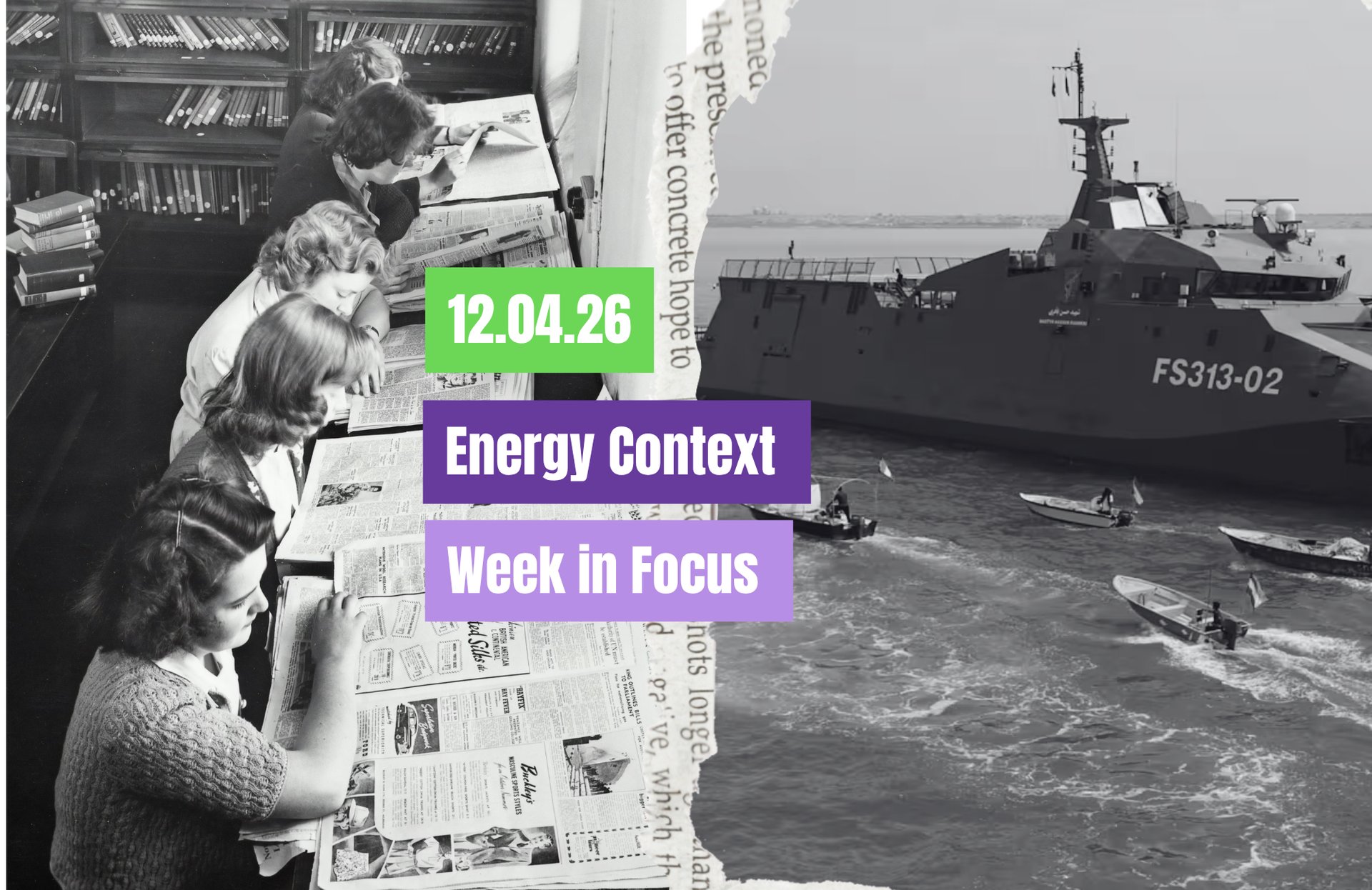
The Global Energy Context in Focus
#ICYMI
Your briefing on everything that matters for the energy business context at the start of the week. We went through dozens of energy news stories and reviewed what matters, so you can get across it, fast.
Week of April 6 – April 12, 2026
The seventh week of the Iran war and the resulting global energy crisis was the most unsettling one yet. It went from the US threatening to strike Iranian bridges and power plants unless Hormuz was opened by Tuesday evening, to a ceasefire announced hours before the deadline, to a failed negotiation in Islamabad late on Saturday, and by Sunday, ending with a US promise to orchestrate a naval blockade on Hormuz for any and all traffic, in retaliation to Iran's practice of charging for passage. This level of bellicosity in both words and action is hard to comprehend, because it breaks all precedent thereby leaving us without historical pattern recognition. No such playbooks exist.
Markets are continuing to under-react to the scale of this physical disruption and its long-lasting impacts on massive parts of the global supply chains. The ceasefire announcement sent oil futures down 14%, but fewer ships transited the strait after the deal than during the heaviest fighting, and Iran halted two previously cleared Qatari LNG tankers, maintaining its total ban on loaded LNG carriers. Physical oil hit record prices (Forties Blend at $147/bbl; Saudi premiums at 26-year highs), while the EIA confirmed 9.1 million bpd of Gulf crude shut in during April.
The 21-hour Islamabad talks, the first direct US-Iran negotiations since 1979, broke down over both sides' inability to move off maximum positions, which included Iran's holding on to nuclear ambitions and control of Hormuz, so President Trump responded by declaring a full naval blockade of the strait, threatening to interdict any vessel paying Iran's toll and to "finish up" what remained of Iran's military.
Meanwhile, the crisis is reshaping global supply chains: US crude exports are projected at a record 5.2 million bpd, India imported record Russian crude, China authorised strategic drawdowns, and across Asia coal plants are being restarted, fertiliser factories shuttered, and sanctioned Russian LNG purchased for the first time.
Beyond the Gulf, the EU softened its methane import regulation under crisis pressure even as the SPE warned that unverifiable emissions data will cost operators market access from 2027; the ECB framed fossil fuel dependence as a threat to monetary stability; and Mexico reversed its fracking ban, Shell accelerated Venezuelan gas development, and Eni made a fast-track gas discovery offshore Egypt, all signs that the supply shock is unlocking projects and policy shifts that were politically impossible six months ago.
The Battle of Narratives: Oil and Gas - Challenge and Opportunity
In the battle of narratives, the crisis is producing two competing responses in parallel: a scramble for alternative oil and gas supply (Mexico reversing its fracking ban, Venezuela production plans accelerating, renewed pressure to reopen North Sea E&P licensing) and an acceleration of the case for energy transition (an ECB official framing fossil dependence as a financial stability risk; reporting on the growing attractiveness of renewables, based on both price and risk hedging; and reiterated storyline about the low-cost of renewables in contrast to the high-cost and geopolitical risk of fossil fuels). For the oil and gas sector, the gap between these two framings is reputationally and strategically critical - it is a challenge as much as an opportunity. The industry has a credible, data-backed demonstration of the oil and gas structural necessity, but that case is being drowned out by authoritative voices using the crisis to argue the opposite on economic, not just environmental, grounds. In crisis mode, few companies have the bandwidth to make this argument well, which leave the narrative to be shaped by others - even when they might not get the engineering, physics, or the financials right.
Read our review to understand the underlying currents of this week's biggest energy context and how to position your organisation effectively within these rapidly evolving market dynamics. If you need to act on any of these topics, we would be delighted to connect on a brief call. You can book directly through the button at the top of this page.
Part 1: The Gulf Crisis
Iran War & Hormuz Crisis Timeline
Monday, April 6
Iran's Revolutionary Guards halted two QatarEnergy LNG tankers (Al Daayen and Rasheeda) that had been cleared to transit Hormuz, confirming that no loaded LNG carrier has successfully passed the strait since the war began. Hormuz saw 21 ships transit over the weekend (the highest two-day total since early March), but passage remained selective, with Iran granting access primarily to allied or neutral-flagged vessels. Saudi Arabia set record official selling prices for May, with Asian buyers paying $19.50/bbl above Oman-Dubai for Arab Light, a premium unprecedented in 26 years of data. Israel attacked South Pars.
Iran halts two Qatar LNG tankers it previously cleared to transit Strait of Hormuz, source says (Reuters)
Hormuz Traffic Rises to Highest in Weeks (Bloomberg)
Saudi Arabia charges record premium for its oil (FT)
The South Pars natural gas complex is an energy lifeline for Iran (AP News)
Tuesday, April 7
A two-week ceasefire was agreed shortly before Trump's deadline to strike Iranian bridges and power plants, sending Brent down 14% to under $95/bbl, but Iran's 10-point plan included maintaining control over Hormuz shipping and demanded sanctions relief, US force withdrawal, and protection of its "Axis of Resistance." The EIA estimated Gulf crude shut-ins at 9.1 million bpd in April, with output not returning to near pre-conflict levels until late 2026. Trump separately floated seizing control of Iran's oil sector as trade leverage against China.
US and Iran agree 2-week ceasefire that will open Strait of Hormuz (FT)
MidEast Crude Output Seen Dropping by 9 Million Barrels a Day (Bloomberg)
Trump Floats Seizing Iran Oil as He Weighs Chinese Leverage Play (Bloomberg)
Can Iran charge fees for ships to transit the Strait of Hormuz? (Reuters)
Natural Gas in Focus: Iran Conflict Could Have 'Very Painful' Consequences (Goldman Sachs)
Wednesday, April 8
Qatar began mobilising engineers for a restart of undamaged LNG capacity at Ras Laffan (83% of 77 mtpa), though the remaining 17% (~12.8 mtpa) requires three to five years to rebuild, and two loaded tankers had been turned back earlier in the week. European gas prices fell nearly 20% toward €43/MWh on the restart news. The Philippines declared a national energy emergency as diesel prices doubled, purchased Russian oil for the first time in five years, and raised the prospect of energy cooperation with China in disputed South China Sea waters.
Qatar Begins Work to Resume LNG Production After Ceasefire (Bloomberg)
How China Built Its Vast Natural Gas Stockpile (NYT)
The south-east Asian country at the sharp end of the energy crisis (FT)
Thursday, April 9
Forties Blend physical oil hit almost $147/bbl, exceeding the 2008 financial crisis peak, as the gap between physical barrels and futures breached ICE's contracts-for-difference threshold, disrupting hedging markets. Saudi Arabia disclosed 600,000 bpd of production capacity and 700,000 bpd of East-West pipeline throughput lost to strikes. Fewer vessels passed the strait after the ceasefire than during the heaviest fighting (4 ships on Wednesday vs 11 on Tuesday), as Iran demanded IRGC approval, cryptocurrency payments, and maintained mining of shipping lanes; over 900 merchant vessels remained stuck in the Gulf.
North Sea oil prices hit record high as Iran keeps hold over Strait of Hormuz (FT)
Oil Holds Gain After Attacks Lower Saudi Production Capacity (Bloomberg)
Oil pares gains to close up 1% as Israel plans peace talks with Lebanon (Reuters)
Chevron sees Iran war oil boost, warns hedging to weigh (Reuters)
Exclusive: Iran war doubles Russia's main oil revenue to $9 bln in April, Reuters calculations show (Reuters)
US oil exports to hit record as Iran war triggers race for supplies (FT)
UK becomes top destination for US jet fuel after Gulf flow squeeze (FT)
Shipping stalls as Tehran dictates terms in Strait of Hormuz (FT)
Russia Offers Sanctioned LNG to Energy-Hungry Asia at a Discount (Bloomberg)
Asia's Gas Shock Playbook: Coal, Curtailment, and Competing for LNG (Anne-Sophie Corbeau, Columbia CGEP)
Friday, April 10
US-Iran peace talks began in Islamabad, the first direct negotiations since the 1979 revolution, with VP Vance leading the US delegation opposite Iran's parliament speaker Ghalibaf. India imported a record 1.98 million bpd of Russian crude in March as fading sanctions enforcement and the Hormuz supply crunch drove a pivot to Russian supply. China authorised state refiners to draw down commercial oil inventories of up to 1 million bpd over April to June from an estimated 851 million barrels of stocks. EU imports from Russia's Yamal LNG project rose 17% to 5 million tonnes in Q1 2026, with Europe receiving 97% of Yamal's cargoes.
US-Iran Peace Talks Near With Hormuz, Lebanon Top of Agenda (Bloomberg)
India Splurges on Russian Oil as Sanctions Threat Begins to Fade (Bloomberg)
China Allows State Oil Firms to Tap Their Reserves as War Drags (Bloomberg)
EU boosts imports of Russian gas as Middle East crisis squeezes supplies (FT)
Saturday, April 11
A panicked race for physical barrels gripped global oil markets: traders submitted 40 bids with only 4 met in the North Sea, Nigerian cargoes commanded $25/bbl premiums (vs less than $3 pre-war), and US gasoline inventories fell to a 16-year low. "Fortress China" showed cracks as polyethylene prices doubled, helium surged 110%, and Xi doubled down on electrification and renewables for energy security while implementing de facto export bans on diesel and jet fuel. The FT published a comprehensive damage assessment: approximately 10% of global crude remains shut in, with Rystad estimating six months to normalise even with a durable ceasefire.
A Panicked Race for Barrels Is Gripping the Global Oil Market (Bloomberg)
'Fortress China' shows cracks as Iran war strains supply chains (FT)
The damage wrought to the Middle East's oil and gas supplies (FT)
UK households turn to solar panels as energy bills bite (FT)
Sunday, April 12
The 21-hour Islamabad talks ended without agreement, with the nuclear issue confirmed as the deal-breaker; hours later, Trump announced the US Navy would blockade all ships entering or leaving the Strait of Hormuz, threatening to interdict any vessel paying Iran's toll and destroy Iranian-laid mines. The FT's chokepoint tracker recorded just 36 vessel movements over the weekend (vs 172 on a single pre-war Sunday). Saudi Arabia restored its East-West pipeline to full 7 million bpd capacity.
US and Iran fail to reach deal after marathon talks (FT)
Trump Says US to Sever Key Iran Lifeline With Blockade of Strait (Bloomberg)
Trump announces naval blockade of Strait of Hormuz as Iran peace talks fail (FT)
Saudi Arabia Says East-West Pipeline Restored to Full Capacity (Bloomberg)
Fees for seas: a history of taxing waterways (FT)
Part 2: Key Energy Context Beyond the Gulf
From the Real World
UK pubs and restaurants face 'permacrisis' after energy shock
Financial Times · Tue 7 Apr 2026
#UKHospitality UK independent hospitality businesses face a compounding cost squeeze as Iran-war-driven energy price rises coincide with April's minimum wage and business rates increases, with off-grid rural businesses paying nearly double for heating oil. The sector illustrates how the Hormuz crisis transmits into consumer-facing economies: almost two-thirds of hospitality businesses plan to cut jobs, and 15% feared closure even before the war began.
https://www.ft.com/content/a246f17b-d99b-4074-9fb6-5ff5266463ae
Reputation & Positioning
Europe's fossil fuel dependence poses risks to price stability
Financial Times · Tue 7 Apr 2026
#ECBFossilflation ECB Executive Board member Frank Elderson argues that Europe's fossil fuel import dependence directly undermines the ECB's price stability mandate, citing "fossilflation" (inflation to 10.6% in October 2022 from the Ukraine shock) and the current Iran crisis as evidence. The piece explicitly frames fossil fuel dependence as a central banking problem, argues the energy transition investment (€660bn/year 2026–2030) is offset by €400bn/year in current fossil fuel imports, and positions the EU Emissions Trading System as essential infrastructure for price stability.
https://www.ft.com/content/6fa21bdb-1387-4fb8-afc9-3d0b53affa58
Will the Iran war derail the energy transition?
Financial Times · Wed 8 Apr 2026
#TransitionOutlook The Iran war is producing a short-term coal rebound (Thailand, Japan, South Korea lifting caps; Italy delaying coal phase-out to 2038; Germany's coal output exceeding gas) but analysts expect longer-term renewables acceleration, as global renewable capacity has climbed ~50% since end-2022 to 5.1 TW while coal grew only 6% to ~2.2 TW. Solar panel prices fell ~70% between 2022 and end-2025, Thunder Said Energy upgraded its 2026 global solar forecast by 100 GW to 830 GW, though countervailing risks include higher interest rates, populist pushback on green agendas, and grid access constraints.
https://www.ft.com/content/1ede9e81-6d4d-49cc-95f7-b733776ff9ae
UK opening new oil and gas fields would imperil global climate goals, experts say
The Guardian · Wed 8 Apr 2026
#NorthSeaClimate Climate diplomacy figures including Lord Stern and former UNFCCC executive secretary Christiana Figueres warned that licensing new North Sea fields (Rosebank and Jackdaw) would undermine UK climate leadership and encourage developing countries to exploit their own fossil reserves. Rosebank and Jackdaw would displace only 1% and 2% of UK gas imports respectively, and the North Sea is more than 90% depleted, making the security-of-supply argument weak; the UK government has maintained its position of no new exploration licences.
Macros
Why this oil shock is different
Financial Times · Mon 6 Apr 2026
#OilShockDebt Ruchir Sharma argues that unprecedented government debt levels (G7 average >100% of GDP, up from 20% in the 1970s oil shocks) limit the fiscal response to the Iran energy shock; global debt hit a record $348tn in 2025, the US deficit is near 6% of GDP and could approach 7% this year. The analysis identifies the US and UK as the most vulnerable developed economies, while 3 of 4 developed-country central banks are missing inflation targets, constraining monetary easing even as growth slows.
https://www.ft.com/content/2b6afabf-6193-4339-b084-a0fb927a8f1d
EIA Annual Energy Outlook 2026 projects US natgas production growth
EIA · Sun 12 Apr 2026
#EIAEO2026 The EIA projects US natural gas production growing from 107 bcf/d (2025) to 133–151 bcf/d by 2050, driven by domestic and international demand, with data centre load as the dominant driver of long-term electricity growth (0.9–1.6%/year through 2050). US crude oil production is projected to decline modestly from 13.6mn bpd (2025) to 12.4–12.7mn bpd by 2050 as prime drilling acreage dwindles, while gas, solar, and wind account for 80% of generation by 2050.
https://www.eia.gov/pressroom/releases/press587.php
Electricity & Renewables
Power-starved Cuba deepens reliance on Chinese solar tech
Financial Times · Mon 6 Apr 2026
#ChinaSolarExport Cuba has installed 1.2 GW of Chinese-supplied solar capacity (a 350% increase on 2024), generating roughly 9% of its electricity from solar, as Trump's near-total oil blockade worsens chronic power shortages. The island's pivot illustrates how energy insecurity in small, import-dependent economies accelerates Chinese clean-tech penetration, though Cuba's grid, storage, and payment constraints limit the transformative potential.
https://www.ft.com/content/8ea8cbf5-4980-49cf-a757-32e68390e27f
China's Wasting Too Much Renewable Power as Curtailments Rise
Bloomberg · Wed 8 Apr 2026
#ChinaCurtailment China's solar curtailment rate rose to 9.2% in Jan–Feb 2026 (from 6.1% a year earlier) and wind to 8.5% (from 6.2%), approaching the 10% ceiling relaxed in 2024, as the grid struggles to absorb record renewable installations. The curtailment crisis threatens project economics and signals that without faster grid expansion and storage deployment, China's clean energy boom could stall, with annual solar installations forecast to fall to as low as 180 GW from 315 GW in 2025.
China Battery Storage Maker Sees Profit Boost from Iran Upheaval
Bloomberg · Fri 10 Apr 2026
#BatteryStorage Ningbo Deye Technology expects Q1 net profit of 1.1–1.2 billion yuan ($176mn), a 56–70% year-on-year increase, driven by surging overseas demand for residential energy storage from Europe, the Middle East, and Southeast Asia as the Iran war intensifies energy insecurity. The result is the first concrete evidence that Chinese battery storage manufacturers are direct commercial beneficiaries of the Hormuz crisis, with Citi projecting further sales growth in Q2 on soaring energy prices.
Emissions & Climate
Exclusive: JPMorgan strikes carbon removal deal that doubles as wildfire prevention
Axios · Thu 9 Apr 2026
#CarbonRemoval JPMorgan signed a 60,000-tonne, 10-year carbon removal deal with Graphyte, which compresses agricultural and forestry waste and stores it underground, with a planned Arizona facility using forest-thinning material that also reduces wildfire risk. The deal signals that carbon removal is advancing through co-benefit framing (wildfire prevention, rural jobs) rather than climate policy alone, though volumes remain negligible against the US's ~5 billion tonnes of annual CO2 emissions.
https://www.axios.com/2026/04/09/carbon-removal-wildfire-prevention-jpmorgan
Gas & LNG
Eni Unveils 2 Tcf Gas Discovery Offshore Egypt, Unlocking Fast Track Development Potential
Eni · Tue 7 Apr 2026
#EgyptGasDiscovery Eni announced a 2 tcf gas and condensate discovery (Denise W 1) in the Temsah Concession offshore Egypt, located 70 km offshore in 95m water depth and less than 10 km from existing infrastructure, enabling fast-track development; Eni operates at 50% with BP holding the remaining 50%. The near-field discovery in the Eastern Mediterranean reinforces the infrastructure-led exploration strategy and supports Egypt's goal of boosting reserves and production for energy security, at a time when regional gas supply is under extreme strain from the Hormuz closure.
Sheinbaum proposes fracking plan as Mexico seeks to curb its reliance on US gas
Financial Times · Thu 9 Apr 2026
#MexicoFracking Mexico's President Sheinbaum announced a plan to exploit 141 tcf of unconventional gas reserves through fracking (subject to a two-month environmental review), which could more than double production to 5.8 bcf/d by 2035 from the current 2.3 bcf/d; the move reverses her predecessor's attempt to constitutionally ban fracking. Mexico imports ~75% of its gas from the US (the world's largest buyer of US natural gas), and the Iran war energy shock has accelerated a politically sensitive pivot toward domestic unconventional supply, though success depends on opening the sector to private investment.
https://www.ft.com/content/c89bf731-0f5f-4311-94ab-554cfa0083f5
Exclusive: Shell seeks to begin gas output at massive Venezuela-Trinidad Loran Manatee field next year
Reuters · Thu 9 Apr 2026
#CaribbeanGas Shell plans first gas from the Manatee field (2.7 tcf reserves) by mid-2027, with pipeline capacity to Trinidad increased to 1 bcf/d (from 700 mcf/d originally), while the larger Venezuelan-side Loran field (7.3 tcf) has no FID yet; Trinidad's NGC is also pushing to restart the mothballed Train 1 of Atlantic LNG. The acceleration of Caribbean gas development, including fresh talks on the 4.5 tcf Dragon field (Shell 80%, NGC 20%), reflects how the Hormuz crisis is unlocking stalled projects and reviving mothballed LNG infrastructure in the Western Hemisphere.
Turkey opposes Ukraine proposal to ship LNG through Bosphorus
Middle East Eye · Sun 12 Apr 2026
#BosphorusLNG Turkey is likely to reject Ukraine's proposal to transit LNG tankers through the Bosphorus to a planned Black Sea FSRU, citing explosion risk in the narrow strait (700 metres at its narrowest), congestion (40,172 ships transited in 2025), and the precedent it would set for Russian LNG cargo routing. The dispute highlights how the Hormuz crisis is triggering secondary chokepoint pressures: Ukraine has lost roughly half its domestic gas output to Russian strikes and is importing US LNG via Poland and Baltic terminals, while the Turkey-Bulgaria interconnection bottleneck constrains the pipeline alternative.
https://www.middleeasteye.net/news/turkey-opposes-ukraine-proposal-ship-lng-through-bosphorus
Oil & Petroleum Products
The question over Trump's 'historic' refinery deal: $300bn or $40mn?
Financial Times · Wed 8 Apr 2026
#RelianceRefinery The Brownsville, Texas refinery project Trump heralded as a "historic $300bn deal" with Reliance Industries involves an initial outlay of only ~$40mn (below stock exchange notification threshold), with the $300bn figure based on a 20-year calculation of crude purchases ($125bn) and refined product sales ($175bn). The announcement is entangled with US-India trade diplomacy: it came after a delayed interim trade deal with Modi, Trump's demand that India stop buying discounted Russian oil, and extensive Ambani-Trump business ties including a $10mn Trump Organization development fee.
https://www.ft.com/content/f217467c-e113-4aa2-ac5e-7046a1dc9be0
Policy & Compliance
Prove It or Lose It: How Rigorous Methane Programs Will Define Global Oil and Gas Market Access
JPT/SPE · Mon 6 Apr 2026
#MethaneCompliance An SPE Methane Technical Section interview outlines how the EU Methane Regulation is converting methane management from a voluntary credibility exercise into a commercial and regulatory requirement: from 2027, importers must demonstrate MRV equivalence for contracts concluded after August 2024, with methane-intensity reporting from 2028 and intensity requirements from 2030. Operators whose data cannot be defended face commercial drag, weaker contract terms, and restricted market access; the competitive advantage will go to operators that can prove, not just claim, methane performance.
EPA takes early step in methane rule rollback
The Hill · Tue 7 Apr 2026
#USMethaneRollback The Trump EPA published a rule extending the emergency flaring window for new oil wells from 24 hours to 72 hours, the first step in a broader rollback of Biden-era methane regulations; the administration says the changes will save the sector ~$208mn annually but did not calculate climate impacts. EDF described the move as a "harbinger" of a broader effort to weaken oil and gas methane regulation, creating a regulatory divergence with the EU's simultaneous tightening of methane import standards.
https://thehill.com/policy/energy-environment/5818608-epa-methane-rule-flaring/
EU to relax methane rules to secure energy supplies
Financial Times · Thu 9 Apr 2026
#EUMethaneFlexibility The European Commission will recommend "flexibilities" to its 2024 methane import regulation: importers will need to demonstrate that a sufficient share of national production meets requirements rather than tracking "back to the well" for each cargo, and penalties (up to 20% of annual turnover) will be softened. Rystad analysis for EDF projects compliant gas supplies will be twice the EU's total 2027 demand, but only 7% of global production currently meets voluntary reporting requirements (Wood Mackenzie); the changes respond to member state pressure and industry warnings that the rules endanger supply security.
https://www.ft.com/content/bf577c80-e3d0-463e-87ee-cc029add0b79
Sources
FT, Bloomberg, Reuters, NYT, AP News, Goldman Sachs, Columbia CGEP, EIA, Eni, Axios, The Hill, The Guardian, JPT/SPE, Middle East Eye, BOE Report, Truth Social
Statem helps energy and adjacent businesses get clarity and strategic positioning with rapid tactical briefs, strategic communications support, and full-service brand building. Our clients choose us for our deep sector knowledge.
Want to receive these contexts directly in your inbox ?
Building Smarter Energy Communications
© 2026. All rights reserved.
Send us a message, or
Book a free discovery call, or send us an email.
contact@statem.net