
Deadlocked in Hormuz as the World Runs Short | Strategic Energy Briefing Week in Focus | May 4-10
Your weekly strategic energy briefing: the Gulf crisis timeline and the global energy stories that shape the narrative."
CONTEXTRESEARCHNEWS & NARRATIVE
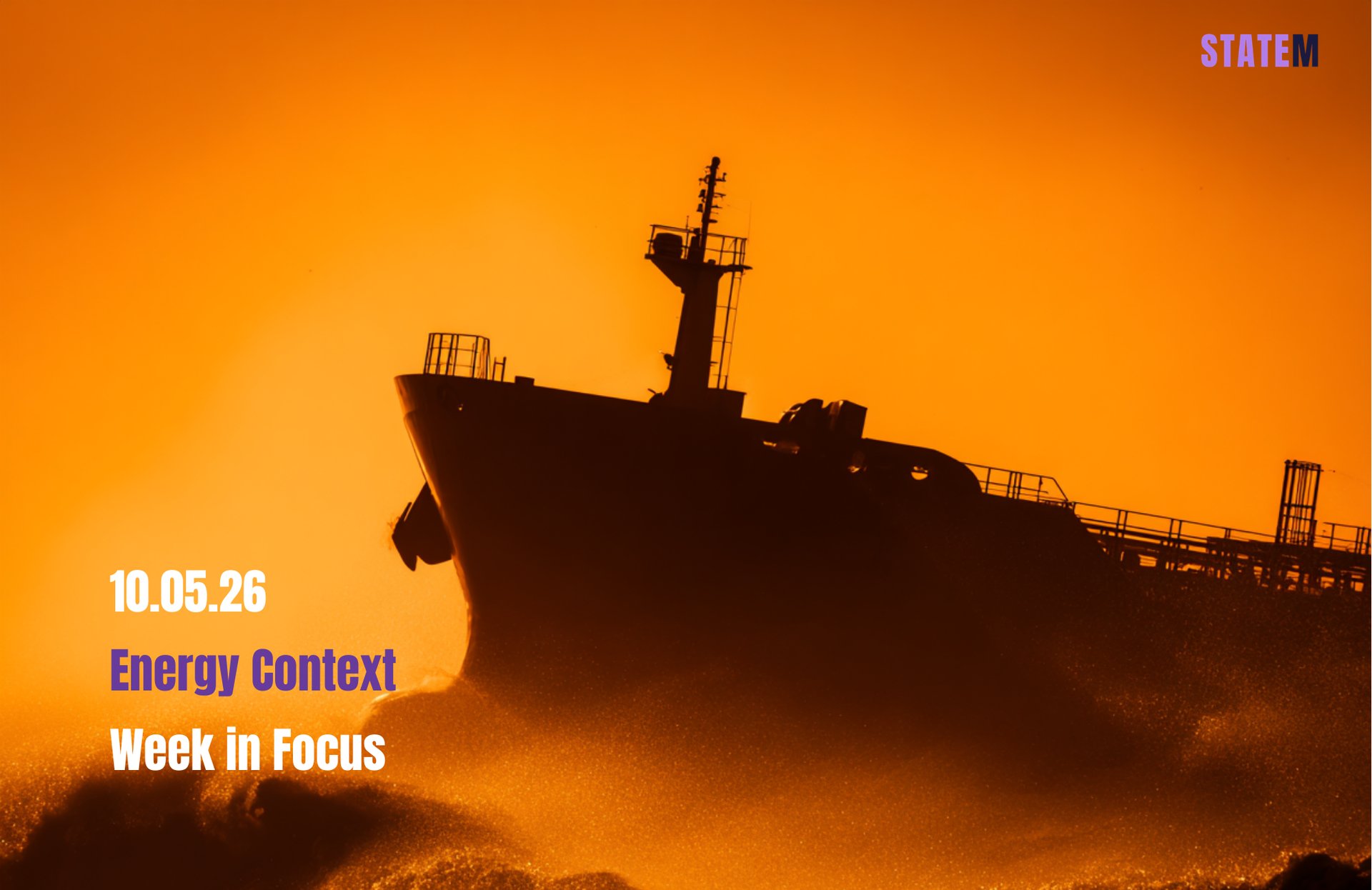
The Global Energy Context Week in Focus
Subscribe and get the briefing in your inbox each week.
Your briefing on everything that matters for the energy business context at the start of the week. We went through dozens of energy stories and reviewed what matters, so you can get across it, fast.
Global energy context that gives your narrative substance. Your clear credibility asset.
We also help energy value chain companies build clear and credible communications that reflect their reality, not multi-purpose generalities. Book a discovery call to find out how.
Week of May 4-10, 2026
The Strait of Hormuz remains in "Project Deadlock," with the ceasefire surviving multiple exchanges of fire but no breakthrough on reopening. Iran's response to the US one-page proposal arrived Sunday; President Trump called it "inappropriate" and rejected it, leaving the path forward uncertain ahead of the Trump-Xi summit on May 14-15. Global oil stockpiles fell by nearly 200mn barrels in April, the sharpest monthly drawdown on record, as supply chain damage cascaded from crude into jet fuel, plastics and fertiliser. Record oil and gas profits from Shell, Saudi Aramco and Cheniere are fuelling political momentum for windfall taxes in Europe and the US. Norway reopened three gasfields and offered 70 Arctic exploration blocks; Australia imposed a 20% domestic gas reservation; the UAE set out the strategic logic for leaving OPEC. The IEA framed uncapped methane emissions as a contributor to the energy security crisis, reporting that nearly double the gas lost at Hormuz is wasted annually through leaks and flaring.
Part 1: The Gulf Crisis
Project Deadlock
Not quite at zeitnot, but the clock is ticking. The Strait of Hormuz remains stuck in what Iran's foreign minister called "Project Deadlock," as the fallout of the biggest energy crisis in history accumulates. The energy community and world at large are learning a big lesson about blind spots in scenarios that once seemed impossible. The ceasefire was a hair away from blowing up, as President Trump's escort operation launched Monday, drew Iranian fire that set the UAE's Fujairah oil port ablaze, and was paused by Tuesday; then on Thursday three US destroyers were fired upon transiting the strait, and US forces struck Iranian military targets in response. The ceasefire still held, pointing to just how challenging the situation is; no easy way out in either direction. Iran's response to the US one-page proposal arrived on Sunday. President Trump told Axios: "I don't like their letter. It's inappropriate. I don't like their response," without elaborating on the contents. Whether negotiations continue or military action resumes is now the open question, with the Trump-Xi summit in Beijing on May 14-15 adding a deadline.
Behind the lockin, ADNOC kept a trickle of crude and LNG moving by sailing tankers with transponders off, Iraq offered discounts of up to $33.40 per barrel to any buyer willing to enter the Gulf. Pakistan's week captured the volatility of expectations: an emergency LNG tender on Tuesday, then cancellation of all bids by Thursday after PM-level calls with Qatar and Iran, gambling that contracted Qatari cargoes would resume through the strait. The country has received one shipment since early March versus nine per month last year. Gulf producers are simultaneously racing to build alternatives to the strait. Saudi Arabia is promoting Neom's Red Sea port as a trade hub while its East-West pipeline runs at emergency maximum capacity of 7mn bpd. Abu Dhabi is expanding its pipeline to Fujairah; Iraq has announced pipeline plans to Turkey and the Red Sea. An FT editorial calculated that completing all planned links could lift bypass capacity from 40% to roughly two-thirds of pre-war flows, but no route is entirely secure.
The Physical Toll
The physical toll continues to compound. Global oil stockpiles fell by nearly 200mn barrels in April, the sharpest monthly drawdown on record, even as demand collapsed by 5mn barrels per day. US diesel stocks hit a 20-year low. Asia's jet fuel exports plunged to one-third of pre-war levels. A naphtha shortage forced petrochemical shutdowns in Indonesia, Japan and Taiwan, triggering a "plastic shock" now squeezing food packaging, medical supplies and consumer goods across the region. Airlines cut 2mn seats from May schedules as jet fuel costs doubled. The UAE's Fertiglobe is trucking fertiliser overland to ports outside the strait, running plants at full capacity because urea prices have nearly doubled, making the double-handling cost worthwhile. European gas traders began hedging for winter prices above €100 per megawatt-hour, more than double current levels.
Crisis Timeline
Monday, May 4
US and Iran launch new attacks as they wrestle for control of Gulf waters (Reuters)
Saudi Arabia touts new use for Neom port after Iran war (FT)
UAE fertiliser giant resorts to trucks to shift product out of Gulf (FT)
India's Petronet expects to receive full supply of Qatar LNG after crisis ends (Reuters)
Iraq Slashes Oil Prices for Buyers Willing to Transit Hormuz (Bloomberg)
Qatar Extends Force Majeure on LNG Supply Through Mid-June (Bloomberg)
Tuesday, May 5
Global oil reserves plunge at record pace as Middle East war strains supplies (FT)
Consumers face more pain as companies threaten price rises (FT)
Wednesday, May 6
Trump says operation to reopen Strait of Hormuz will be 'paused' (Reuters)
US fuel exports hit record in boon for oil companies and threat to Trump (FT)
Pakistan Seeks Emergency LNG Supply to Ease Natural Gas Shortage (Bloomberg)
Europe Gas Traders Buy Options to Hedge for Winter Price Spike (Bloomberg)
Thursday, May 7
Asia exports of refined fuels plunge amid Hormuz closure (Reuters)
Exclusive: Hungry to sell, UAE slips hidden oil tankers through Strait of Hormuz (Reuters)
McDonald's warns of price pressures from rising beef and energy costs (FT)
'Plastic shock' hits Asia as Iran oil crisis strangles supplies (FT)
Adnoc's LNG Tankers Go Dark to Get Gas Shipments Through Hormuz (Bloomberg)
Oil Steadies as the US and Iran Weigh Fresh Proposal to End War (Bloomberg)
US Waits for Iran's Peace Deal Response as Israel Hits Lebanon (Bloomberg)
Friday, May 8
US, Iran Clash Near Hormuz as Response on Proposed Deal Awaited (Bloomberg)
Oil Jumps Following Fresh Clashes Between US and Iranian Forces (Bloomberg)
Pakistan Shuns Spot LNG as It Bets on Potential Hormuz Easing (Bloomberg)
Saturday, May 9
Sunday, May 10
Saudi Aramco profits rise as oil price surge and pipeline offset Iran war hit (FT)
Australia's 'petro-diplomacy' eases fuel shortage fears (FT)
Trump to Axios: "I don't like" Iran's peace plan response (Axios)
Part 2: Key Energy Stories Beyond the Gulf
Windfall Flex
Further oil and gas company profit reports are rolling in, which fuels the temptation for windfall taxes by governments (Shell posted Q1 adjusted profit of $6.92bn; Saudi Aramco earned $33.6bn, up 26%; Cheniere raised its full-year guidance on stronger LNG margins despite reporting a quarterly net loss from derivative positions). These are cyclical commodity returns in a supply-short market, but the optics are still familiar ground for political redistribution flex. Finance ministers in Germany and Italy, along with some US Senate Democrats, are calling for levies on war-related profits. In the US, proposals for a federal gas tax holiday are gaining traction; Rapidan Energy gives a 25% chance of Congress suspending the 18.3 cents per gallon federal tax, though the Bipartisan Policy Center estimates it would cut pump prices by only 9-14%, far from offsetting the $1.50 per gallon increase since the war began. The cost pressure is reaching consumers; P&G warned of a $1bn hit from elevated oil prices, Colgate-Palmolive flagged $300mn in additional costs, and references to "pricing action" in S&P 500 earnings calls have climbed to the highest level since 2022.
Is It Time to Tax the Oil and Gas Industry's Windfall? (NYT)
Cheniere reports Q1 loss but raises 2026 outlook on higher LNG output, margins (Reuters)
Policy tugs and upstream winds of change
In the same week, the EU Commission drafted guidelines that would suspend methane emissions penalties during supply crises, with no time limit, after lobbying from the US government and the industry. Shell, separately, pushed to delay EU rules requiring hourly matching of renewable electricity for green hydrogen production, arguing they would add €2 per kilogramme to costs. The EU also issued guidance on the simplified ESG reporting.
A wind of major change on upstream activity in Europe came as Norway reopened three gasfields closed in 1998, with production from 2028, and offered 70 new exploration blocks, more than half in the Arctic.
Meanwhile, Australia imposed a 20% domestic gas reservation on east coast LNG exporters and secured bilateral fuel supply agreements with Japan, South Korea, Singapore, Malaysia and Brunei, as US refined fuel exports hit a record 8.2mn barrels per day, briefly making America a net crude exporter for the first time since WWII, though at the cost of depleting its own inventories toward unprecedented summer lows.
And on the other side of the globe, just as it closed the fossil fuel phaseout summit the week before, Colombia moved to prioritise a $150mn LNG import terminal as its gas shortfall reached 20% of demand.
EU weighs get-out for gas leaks after US and fossil fuel industry pressure (FT)
EU floats making it easy for oil companies to break methane rules (POLITICO)
Shell lobbying EU over rules on how green its green hydrogen must be (FT)
EU Releases Proposed Finalized Mandatory and Voluntary Sustainability Reporting Standards (ESG Today)
Norway to reopen three gasfields closed down last century (FT)
'We are talking about energy security for Europe': Norway doubles down on oil and gas production (The Guardian)
Australia to Make LNG Projects Supply 20% of Gas to Local Market (Bloomberg)
Australia requires LNG exporters reserve 20% of gas for east coast market (Reuters)
Colombia Gives Priority to TGI's LNG Project as Gas Dwindles (Bloomberg)
European Chemicals are down to litigate for survival
EU anti-dumping complaints against Chinese chemicals have reached an all-time high, with chemicals now accounting for half of all new trade defence cases. The European chemical industry has shut 7% of capacity, with closure rates doubling annually; some chemicals are down to a single EU producer, and the bloc can no longer domestically manufacture products like paracetamol. Ineos alone filed 10 complaints in November. The sector sits at the intersection of trade, energy costs and industrial sovereignty, with 26 complaints still awaiting investigation.
End of an era
In an FT Op-ed, where as much could be read between the lines, as on them, the UAE's ambassador to the US set out the strategic logic behind the country's exit from OPEC, announced last week. "We are not choosing between oil and the energy transition. We are funding one with the other... Like that suit and tie from 1986, we had outgrown Opec," wrote His Excellency Yousef Al Otaiba. Production capacity targets are 5mn barrels per day by 2027. The ambassador pointedly noted that Iran remains an OPEC member in good standing while actively undermining the organisation's stated mission of supply stability.
Africa refines
Africa was the good news story, as it is reaching a breakthrough in domestic energy value addition with the help of homegrown poster child Nigerian industrialist and billionaire, Aliko Dangote. Dangote's 650,000 bpd Lagos refinery hit full capacity weeks before the war, and Nigeria has avoided the fuel queues and rationing seen across other African countries; fertiliser prices have doubled and jet fuel is being diverted to European airlines at premium margins. Dangote is now planning a second 650,000 bpd refinery in East Africa, estimated at $15-17bn, while pressing ahead with doubling Lagos to 1.4mn bpd. Angola also fired up the Cabinda refinery, its first since independence in 1975. Africa currently exports three-quarters of its crude and imports 70% of refined fuel at an annual cost of $50bn in lost value; the crisis is adding situational urgency to a structural shift that has been slowly building through local capital and local ambition.
Africa's Newest Oil Refinery Fires Up to Supply Fuel for Angola (Bloomberg)
Aliko Dangote's Group Eyes More Dollar Bond Sales to Fund Growth (Bloomberg)
It's time to feed your Claude
The tension between AI energy demand and grid capacity grows. NERC issued a rare Level 3 alert after data centre loads exceeding 1GW disconnected from the grid without warning. PJM (stands for Pennsylvania-New Jersey-Maryland Interconnection), the largest US power market, questioned its own market design in a 70-page white paper (see research bank). Microsoft weighed abandoning its 2030 clean-energy matching target, holding talks with Chevron on a natural gas plant in West Texas; Constellation Energy is restarting Three Mile Island's 835MW reactor under a 20-year Microsoft power purchase agreement, targeting mid-2027. Carlyle and Diversified Energy structured a $1.2bn securitised acquisition of Oklahoma oilfields, framed as "a differentiated play on the AI theme," channelling private credit into gas production underpinned by future well revenue.
The AI Revival of the Three Mile Island Nuclear Plant (Bloomberg)
Microsoft in Talks to Ax Key Energy Pledge Amid Data Center Boom (Bloomberg)
NERC sounds the alarm that data centers risk overtaxing the grid (Latitude Media)
In pivotal move, PJM puts new power market designs on the table (E&E News)
Carlyle teams with Diversified Energy on $1.2bn oil and gas venture (FT)
The transition. It's electric.
European heat pump sales rose 16.5% in Q1, with Germany up 34% and Finland 71%; South Korean EV sales more than doubled and solar panel imports hit a record; record UK wind and solar output avoided £1.7bn in gas imports since the war began, according to Carbon Brief. But Europe's solar glut is producing its own problems, with negative pricing episodes undermining the economics of all generators in Germany, Poland and Hungary. Spencer Dale, a former Bank of England and BP chief economist argued that the crisis will not uniformly accelerate the transition; for many countries, the energy security imperative means more coal, not less, and governments are already deprioritising sustainability for security. The growing dissonance between transition ambition and the immediate requirement for hydrocarbon insurance is now the central tension in energy policy worldwide.
Heat pump sales jump as consumers recoil at high fossil fuel prices (FT)
Analysis: Wind and solar have saved UK from gas imports worth £1.7bn since Iran war began (Carbon Brief)
Europe's solar glut shunts power system into tricky new transition phase (Reuters)
Why the Iran war might not spur a faster transition to low-carbon energy (FT)
Iran Shock Boosts South Korea's Push to Cut Fossil Fuel Imports (Bloomberg)
Reputation and public opinion
The New York State Common Retirement Fund ($298bn assets under management) warned TotalEnergies that its decision to accept $928mn from the Trump administration to terminate two US offshore wind leases and redirect investment into fossil fuels raised "significant concerns" about strategic consistency and said it was re-evaluating its stake. On the other side of the narrative, the Trump Justice Department sued Minnesota to block the state's six-year-old consumer protection lawsuit against Exxon, API and Koch Industries, arguing that climate regulation is a federal prerogative. Norway's gasfield reopening drew accusations of "greenwashing through and through" from the Socialist Left party.
US pension fund threatens to divest TotalEnergies stake over offshore wind exit (FT)
Trump Administration Sues Minnesota to Block Climate Lawsuit (NYT)
Norwegian government attacked over decision to reopen North Sea gasfields (The Guardian)
Meanwhile, the climate is changing
Copernicus data confirmed April 2026 as the joint third-warmest April on record, 1.43°C above pre-industrial levels, with sea surface temperatures transitioning toward El Niño conditions and record marine heatwave activity extending from the central Pacific to the US west coast. And a Nature Sustainability study concluded that New Orleans has crossed a "point of no return," with 3-7 metres of projected sea-level rise set to push the Gulf of Mexico shoreline 100km inland before the century's end, calling for immediate managed relocation of the city's 360,000 residents.
Surface air temperature for April 2026 (Copernicus)
'Point of no return': New Orleans relocation must start now due to sea level, study finds (The Guardian)
The energy research bank refills
In the research bank, we have two important reports this week. First, the IEA's Global Methane Tracker reported that more than double the volume of gas cut off by Hormuz is being wasted each year through uncapped methane emissions and unnecessary flaring: 200 bcm recoverable annually versus the 110 bcm of LNG that transited the strait last year. The agency framed methane abatement explicitly as an energy security measure. Second, US PJM electrical grid jurisdiction (stands for Pennsylvania-New Jersey-Maryland Interconnection) issued a study warning that the regional electricity grid is facing a severe power shortage that leads to sudden price spikes, political backlash, and stalled investment as a result of skyrocketing demand from data centers, retiring power plants, and slow construction times. The findings to maintain reliability boiled down to a choice between requiring long-term, fixed-price electricity contracts to protect consumers from unpredictable bills, explicit rationing who loses power first during grid emergencies, or changing the rules so power plants make their money by successfully generating electricity during real-time crises instead of receiving standby payments.
More than double the gas stuck in Hormuz is wasted each year, IEA says (FT)
France urges faster methane cuts as emissions remain at record high (RFI)
In pivotal move, PJM puts new power market designs on the table (E&E News)
The energy research bank refills
India's rupee hit a historic low above 95/$ as foreign investors pulled a record $21bn from stocks since the war began. Qatar extended force majeure on LNG supply through mid-June. Turkey signed ~10 new LNG supply deals, positioning itself as a regional gas gateway to Central and Eastern Europe. Europe's power grid operators are ramping physical and cyber defences, with the EU estimating €1.2tn in grid investment needed by 2040. An incredible story from the FT investigation takes you to the real operations of a shadow tanker fleet; great read. Diamondback Energy began raising Permian Basin output "immediately." A $750mn solar mini-grid expansion is planned across Uganda, Rwanda, Ethiopia and the DRC, targeting 2.1mn connections. Peter Thiel led a $140mn investment in wave-powered ocean data centres. A Bill Gates-backed fusion start-up plans the UK's first commercial plant by the mid-2030s. The US and South Africa held their highest-level meeting this year on critical minerals cooperation.
Investors dump Indian assets as energy shock sends rupee sliding (FT)
Turkish gas and LNG imports grow, targets to become a regional gas hub (S&P Global)
Sabotage Threats Have Put Europe's Power Networks on Alert (Bloomberg)
US Driller Diamondback Raising Output 'Immediately' on Oil Rally (Bloomberg)
Solar Firm Plans $750 Million Power Grids in Four Africa Nations (Bloomberg)
China State Firm Discusses Major New Copper Mine in Congo (Bloomberg)
Peter Thiel backs $1bn ocean data centre start-up powered by waves (FT)
Fusion start-up backed by Bill Gates plans UK's first commercial plant (FT)
US and South Africa hold talks on mining deals after year of tensions (FT)
SOURCES
FT, Reuters, Bloomberg, Axios, NYT, The Guardian, POLITICO, S&P Global, ESG Today, Carbon Brief, RFI, Latitude Media, E&E News, Copernicus
Statem helps energy and adjacent businesses build outstanding brands that differentiate with credibility and organically earn trust of their stakeholders, investors, and customers.
Our clients choose us for our deep sector knowledge and experience helping energy topics get heard and understood by every imaginable audience.
Want to discuss how to apply this context in your strategic communications? Get in touch at contact@statem.net
Want to receive these directly?
Building Smarter Energy Communications
© 2026. All rights reserved.
Send us a message, or
Book a free discovery call, or send us an email.
contact@statem.net