
De-Wonked: The European Commission Responding to the Ongoing Hormuz Energy Crisis
If your organisation is linked to any part of the European energy supply chain, whether as a producer, consumer, distributor, infrastructure operator, or service provider, chances are this concerns you. Quick diagnostic of the dominant narrative that the European Commission uses to give legitimacy to its proposed set of actions, followed by the full list of the proposed energy tools, stripped of verbosity, simplified, and de-wonked.
NEWS & NARRATIVECOMMUNICATIONS STRATEGYRESEARCH
De-Wonked: The European Commission Communication Announcing Actions in Response to the Ongoing Hormuz Energy Crisis
A quick diagnostic of the AccelerateEU Communication (COM(2026) 370 final)
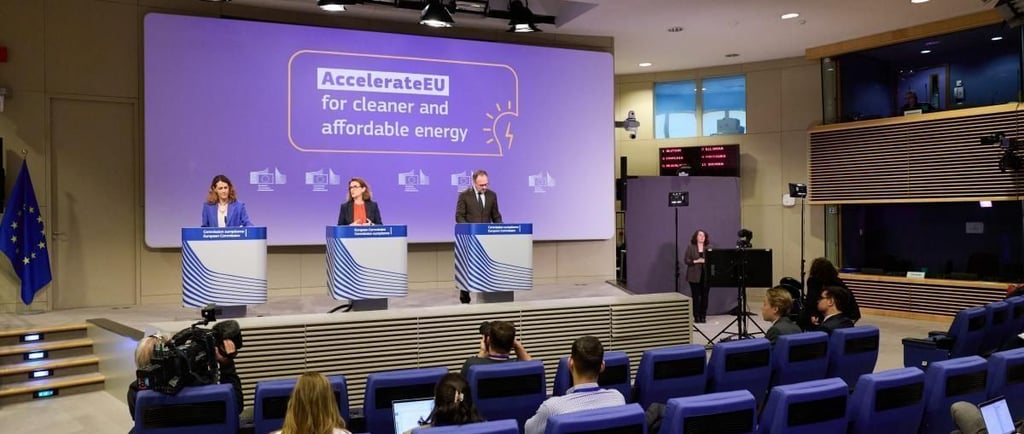
On April 22, 2026, the European Commission issued a 17-page communication announcing a set of policy tools and actions in response to the ongoing Hormuz energy crisis under the heading of AccelerateEU. It presented it as “the Commission’s toolbox to bring immediate relief to European households and industries, especially the most vulnerable ones, while putting Europe on a steady pathway to energy independence.”
The 33 tools are divided into five categories that form a broader narrative, dressed up in longer preambles.
The narrative presents accelerated electrification as the solution to energy and economic insecurity risks posed by imported fossil fuels. The overall strategy behind this communication move looks to be in the spirit of “not wasting a good crisis” and seizing the opportunity to reinforce, and where possible, accelerate existing policy direction.
Studying the narrative opens a door to understanding its base logic and what needs to be true for the proposed course of action or policy to work, and vice versa. It exposes the structure on which the “house” is built, and that is the key for energy sector players to get into an advantageous strategic position and to productively interact with the narrative’s champions and supporters. For policymakers, it is beneficial to check their own narrative for blind spots.
In this post, I share a quick diagnostic of the dominant narrative that the European Commission uses to give legitimacy to its proposed set of actions, followed by their full list, stripped of verbosity, simplified, and de-wonked where possible.
If your organisation is linked to any part of the European energy supply chain, whether as a producer, consumer, distributor, infrastructure operator, or service and equipment provider, chances are this concerns you. It also concerns you if you are a resident and taxpayer.
Part 1: Deciphering the Narrative
“the benefits of accelerating the clean energy transition clearly outweigh its costs”
“The transition to a clean, abundant, homegrown, secure, water-resilient and affordable energy system has never been solely a climate and environmental necessity; it is also a socio-economic, competitiveness and security imperative.”
What is important here is that the climate is deliberately moved to the background, and not being the driving force, it is only mentioned once in passing.
Instead, the economy, resilience, and strategic independence are the drivers.
The narrative positions electrification as the frugal and elegant solution to the energy trilemma, reinforcing each of its three legs: security, affordability, sustainability. This matters for the hydrocarbon value chain, because the trilemma has long been its dominant territory, where the concept of a renewables-driven electrification was visibly weaker on the economic and security aspects; and while this may be a short-lived change in dynamic, it is enough to enable rapid fire policy moves, enabled by the urgency of the crisis.
The moves that will have a real impact on long-term costs and benefits for the users and providers of energy and on “who pays.” For instance, one of the proposals signals providing electricity with preferential treatment, “ensuring that electricity is taxed less than gas.” This one in particular needs a lot of clarification, given that much of the gas currently used in the EU is to produce electricity, hence likely, this is about things like electrifying heating, but it could also be about industrial processes and feedstocks.
What is also notable is what the Communication does not do.
It does not leave any room to assess the current policy direction in the changing context. It does not show openness to confirm whether the existing strategy is adequate, or whether the crisis reveals gaps in the current approach. Instead, it uses the crisis to double down on existing policy, accelerating commitments already made and rebranding them as crisis response. Upon review, working with Claude, of the 33 proposed actions, 7 look like they introduce genuinely new instruments or commitments. The remaining 26 restate, rebrand, or accelerate existing policy. This is not necessarily wrong, but it is good to be clear-eyed about what is being presented and why.
So, here are the main building blocks of the narrative, through a hero’s journey lens, as I see them, roughly speaking.
The Villain: Imported Fossil Fuels
“For the second time in less than five years, the dangers of Europe's dependency on fossil fuel imports are becoming abundantly clear.”
Europe imports 57% of its energy needs via fossil fuels, and that subjects Europe to external, unpredictable risk to energy supply and price rises.
The Proof of Evil and Its Imminent Danger
The economy suffers, jobs are hurt, inflation has increased, vulnerable households and businesses are under threat. “Household budgets are tightening as rising energy costs reduce people's disposable income… The possible effects on GDP growth and inflation are significant.. impacts will continue being felt for at least several months and go well beyond the energy sector, with economic, employment and social impacts."
The EU spent EUR 340 billion on imported fossil fuels in 2025,
It spent an estimated EUR 24 billion extra on price premium on fossil fuel imports in the first 52 days of the Hormuz crisis.
Member States with more renewables and nuclear and less fossil fuels have cheaper electricity; therefore electrification is presented as a cost-saving measure.
Proof of Hero’s Competence
Stay calm, “there is no immediate threat to security of supply,” but there are threats for some fuels. 40% of EU’s jet fuel is imported, and 20% via Hormuz.
“the REPowerEU Plan already helped the EU to reduce its gas demand by 18% (between August 2022 and March 2023), easing immediate pressures and supporting longer-term stability.”
The EU Energy Platform aggregated 90 billion cubic metres of European gas demand and matched 77 bcm with suppliers.
The Hero’s Actions
Protecting the vulnerable with various forms of targeted financial support in the short term.
Accelerating the energy transition via electrification, to safeguard industrial competitiveness against fossil fuel danger, in the long term (also with more support).
“Short-term relief measures must not detract from, but on the contrary, double down on, the longer-term goals.”
The Vision of the Future
“The choices we make today determine whether we face the next crisis from a position of vulnerability or strength”
= Thanks to these actions, the energy transition will be accomplished quickly and provide domestic, clean, abundant energy to replace the danger of imported fossil fuels.
Characteristics of the future energy system (stated policy goals): domestic clean energy production; decarbonised energy systems; a resilient energy system; strong European manufacturing capacity; no strategic dependencies.
What Happens if the Hero Does Not Act
“Every delayed investment in the energy transition risks creating greater costs to society.”
Europeans will continue to be at the mercy of imported fossil fuels, and the next crisis will put them in danger again. Two crises in the last five years prove that the next one is imminent.
The Stated Truth
"Reaching these goals will require strong commitment, intensified coordination and increased investment, but the benefits of accelerating the clean energy transition clearly outweigh its costs."
The drivers are primarily economic and security. Climate is not the driving force; it is a nice bonus.
*** AccelerateEU by the Numbers ***
**Key figures from the Communication
EUR 340 billion spent on imported fossil fuels in 2025
EUR 24 billion price premium on fossil fuel imports in the first 52 days of the Hormuz crisis
57% of EU energy consumption is imported fossil fuels
~40% of EU jet fuel is imported; about half of those imports transit the Strait of Hormuz
EUR 100 billion to be mobilised via a new Industrial Decarbonisation Bank
400 million ETS allowances earmarked for an Investment Booster
EUR 660 billion/year investment needed until 2030 for the energy transition
**Restated targets
100 GW/year renewable deployment target (restated from Clean Industrial Deal)
Heat pumps: annual deployment from ~2.4 million units to ~4 million by 2030
Electricity storage: current 55 GW, target 200 GW by 2030
Electrification rate: 23.4% in 2024, target 32% by 2030 (restated from Clean Industrial Deal)
Permitting: maximum 2 years by end of 2026
260 GW of renewable capacity installed since 2021 (204 GW solar, 57 GW wind), saving ~15 bcm of gas in 2025
Classification of the 33 Actions: New vs. Restated
New (7): 1e Fuel Observatory, 1g Oil Stocks Directive revision, 2c State aid temporary framework, 2g Fisheries crisis mechanism trigger, 3e Hydrogen criteria review + nuclear consultation, 4e Network charges and taxation proposal, 5d ETS modernisation + Industrial Decarbonisation Bank
Restated, accelerated, or expanded (26): 1a Gas storage coordination, 1b Storage filling flexibility, 1c Oil/gas supplier outreach, 1d Refining capacity mapping, 1f Jet fuel/aviation flexibilities guidance, 2a Catalogue of measures, 2b Digital repository, 2d Price subsidies/assistance, 2e Consumer protection (continuation), 2f Social leasing schemes, 3a Electrification/heating/cooling action, 3b Geothermal database, 3c Solar thermal support, 3d Biomethane (explicit REPowerEU restatement), 3f Feedstock mapping, 4a Grids package (call on co-legislators), 4b Energy Highways (continuation), 4c Repowering end-of-life plants, 4d Energy Regulation Academy, 4f Monitor and enforce, 5a Clean Energy Investment Summit, 5b AccelerateEU investment exercise, 5c Assess rule simplification, 5e ETS revenue guidance, 5f Standardised financial products, 5g eSAF Early Movers Coalition (continuation)
Part 2: Summary of Proposed Actions
Below is the full list of proposed actions from the Communication, de-wonked. The hashtags are shorthand tags to make each action scannable. Dates in brackets indicate when the Commission says it will act.
1. Security of Supply and Emergency Coordination Measures
(original: “The benefits of greater EU coordination”)
a. [April 2026 onwards] #CoordinateGasStorageFilling – facilitate the coordination of national gas storage filling, e.g. coordinating with Member States the timing of purchases by market players to avoid price spikes and possible oil stock releases, including of jet fuel and diesel.
b. [April 2026 onwards] #GasStorageFillRequirement – Member States are encouraged to reduce gas storage filling levels to 80% per flexibility threshold, and the Commission might lower this further to 75% under the updated EU Gas Storage Regulation.
c. [April 2026 onwards] #OilandGasImport – coordinate EU outreach to oil and gas suppliers and importers to improve the functioning and transparency of global energy markets. The EC will seek to increase supply from new suppliers.
d. [May 2026] #RefiningCapacity – map refining capacities in Europe, assess needs and work on measures to ensure full use of and sufficient domestic refining capacity for oil products, as well as to increase domestic production of sustainable biofuels.
e. [May 2026 onwards] #FuelObservatory – create a Fuel Observatory, mapping the supply of relevant transport fuels (produced in the EU, imported and exported) and available stocks in the EU, including military fuel stocks and refining capacities where information is available. As an initial priority, the Commission will coordinate with Member States, fuel suppliers and the aviation sector on the sourcing of alternative jet fuel supply and will propose measures to optimise its distribution to ensure availability across all regions and airports.
f. [May 2026 onwards] #JetFuel – clarify existing flexibilities in the EU legislative framework for aviation to address the consequences of potential fuel shortages on air transport, ensuring the single market functions and essential air connectivity is secured. If required, the Commission will propose temporary changes to the applicable EU legislative framework.
g. [2026] #StrategicOilReserve – start to revise the Oil Stocks Directive to address weaknesses and consider whether specific stock requirements are needed for different oil products.
2. Consumer Protection
(“Protecting consumers and industry from price shocks”)
a. [May 13, 2026] #Catalogue – present a catalogue of measures Member States can deploy quickly to cut oil and gas use: covering energy savings, efficiency gains, and substituting fossil fuels with homegrown clean energy. The catalogue will be drawn from the most effective measures taken since 2022 and will feature concrete examples that worked on the ground and could scale across the EU. (Informal EU Energy Ministers meeting in Cyprus.)
b. [April 2026 onwards] #EmergencyRepository – compile and share non-confidential information on Member States’ national emergency measures in a digital repository.
c. [April 2026] #StateAidFramework – adopt a State aid temporary framework for Member States to develop and implement targeted, time-limited emergency measures to support the economic sectors most exposed to price spikes.
d. [April 2026 onwards] #PriceSubsidies – assist Member States in designing targeted, timely and temporary measures, including price interventions, income support schemes and tax incentives, aimed at SMEs, energy-intensive industries and households, while preserving the incentive to save energy and reduce fossil fuel use. Member States are expected to assess fiscal cost and avoid fragmenting the single market. The Commission will provide guiding principles and templates. Member States may also tax windfall profits to ensure social fairness; the Commission will respect those decisions and share best practices, while assessing single-market impact. The Commission also stands ready to support any Member State that needs to temporarily apply energy tax rates below the current EU minimum levels, provided this does not increase fossil fuel demand or worsen supply-demand imbalances.
e. [April 2026] #ContinueConsumerProtection – continue helping Member States implement consumer empowerment and protection measures.
f. [May 2026 onwards] #EVs #HeatPumps #Batteries – develop social leasing schemes for clean and efficient technologies that Member States are encouraged to use to speed up the uptake of e-vehicles, residential heat pumps and small-scale batteries. Ready to help Member States set up financial incentives, such as tax credits, for rapid deployment.
g. [April 2026] #Fisheries – allow Member States to compensate operators in the fisheries, aquaculture and processing sector for increased operating costs and lost income directly stemming from the situation in the Middle East (via crisis support mechanism).
3. More and Faster Clean Energy and Electrification
(“Accelerating the shift to homegrown clean energy and electrification”)
a. [Q2 2026] #SourcePricingPreferences – act on electrification, heating and cooling, and geothermal energy. Among other things, it will set an electrification target, propose action to lower the price ratio between electricity and fossil fuels, and roll out measures to accelerate electrification, including a market-based instrument for heat pumps, while addressing barriers in industry, transport (including heavy-duty vehicles) and buildings, as well as cross-sector barriers. This includes phasing out fossil fuel subsidies, which undermine electricity’s competitiveness against other energy carriers.
b. [May 2026 onwards] #Geothermal – help Member States and stakeholders gather detailed geological data and create an EU-level database for geothermal.
c. [May 2026 onwards] #SolarThermal #SupportSchemes – help develop public support schemes for large-scale solar thermal projects.
d. [2026 onwards] #Biomethane – restating REPowerEU commitment to continue supporting the production of non-fossil gaseous molecules.
e. [Q2 2026] #Hydrogen – following an assessment, and given the slower-than-expected hydrogen ramp-up, the Commission will propose a targeted review of the production criteria for renewable hydrogen, while safeguarding existing investments. This is intended to support industrial decarbonisation and accelerate development of hydrogen-based Sustainable Aviation electro-Fuels (eSAF) and Sustainable Maritime electro-Fuels (eSMF). By 30 June 2026, the Commission will launch a public consultation on a draft methodology outlining criteria for potentially recognising low-carbon electricity from nuclear power plants under alternative approaches.
f. [By summer 2026] #ReplacingFossilFeedstock – map European capacities to “complement” oil and gas as feedstocks for chemicals, ceramics, glass, plastics and fertilisers, using circular and bio-based materials, and work with industry to identify and remove barriers to short-term deployment.
4. Grid and Electrification
(“Stepping up our energy system”)
a. [By July 2026] #GridPackage – the EC calls on co-legislators to conclude negotiations on the grids package by summer 2026 and will support them in doing so. This is essential to speed up the rollout of renewable energy projects and storage (including large-scale batteries) and to upgrade grid infrastructure.
b. [Q2–Q3 2026] #ContinueEnergyHighway – continue working with Member States to fast-track the Energy Highways initiative.
c. [May 2026 onwards] #RepowerRenewables – help Member States and stakeholders identify electricity generation plants, including wind farms, nearing end-of-life that could be repowered to expand electricity supply in the coming months. They will also assess how to scale up renewable deployment further.
d. [May 2026] #RegulationAcademy – help Member States implement key reforms in the electricity sector by providing support via the Technical Support Instrument through an Energy Regulation Academy.
e. [May 2026] #PreferentialTaxTreatment #NetworkCharges – adopt a legal proposal on network charges and taxation aimed at making electricity bills lower for all consumers by enabling a more electrified, efficient, and resilient energy system. It will provide incentives for optimal, cost-effective grid use and system-friendly consumption, allow national regulators to make targeted reductions to network charges (including for energy-intensive industries), and let Member States lift restrictions on cutting energy taxes for specific users like energy-intensive industries and vulnerable households, while ensuring electricity is taxed less than gas.
f. [2026–2027] #MonitorAndEnforce – strictly monitor the implementation of relevant EU legislation using all available tools, including infringements, for example on permitting, storage, flexibility, and maximisation of cross-zonal capacity, to speed up the clean energy rollout. To accelerate progress, it will fast-track the assessment of key provisions, provide pragmatic implementation guidance (including via Commission recommendations), and support Member States in ensuring harmonised, consistent application across the EU.
5. Financing
(“Boosting Investment”)
a. [Q2–Q3 2026] #CleanEnergySummit – host a Clean Energy Investment Summit bringing the financial services industry, institutional investors, industrial leaders, project developers, and public financiers to accelerate private financing.
b. [April 2026 onwards] #ExerciseToSpend – run an EU-wide AccelerateEU investment chapter exercise to help Member States make maximum use of available EU funding (e.g. cohesion policy funds) and reallocate EU funds where feasible, in line with Member State and regional preferences, to energy-related investments that can deliver quick impact and ease the effects of rising energy prices.
c. [April 2026 onwards] #AssessRuleSimplification – assess whether further action is needed to simplify rules and accelerate the deployment of EU funds for energy-transition investment.
d. [By July 2026] #ETSModernisation – adopt a legislative proposal to update and modernise the EU Emissions Trading System (ETS). It will consult Member States on updating the ETS benchmarks soon. Additionally, it will increase financial support for industry’s clean energy transition through the Industrial Decarbonisation Bank, mobilising EUR 100 billion of funding.
e. [April 2026 onwards] #ETSRevenueGuidance – help Member States that want to use EU ETS revenues for electrification, industrial decarbonisation, circular downstream applications, and decarbonisation investments that help reduce electricity prices.
f. [April 2026 onwards] #FinancialProducts – with the European Energy Financing Coalition, develop standardised financial products for clean heating and renovation, and develop and promote new energy-service business models that directly support SMEs rolling out energy efficiency and electrification solutions.
g. [April 2026 onwards] #ContinueESAF – continue supporting Member States in the eSAF Early Movers Coalition, organising the announced EUR 2 billion double-sided auction on eSAF and encouraging more Member States to take part.
Closing Observation
Of the 33 actions announced in the AccelerateEU Communication, 7 introduce genuinely new instruments or legislative proposals. The remaining 26 restate, rebrand, or accelerate commitments the Commission had already made, in many cases under REPowerEU or the Clean Industrial Deal. The response to the real and legitimately dangerous energy crisis is mostly a reframing of existing policy, with some specific short-term tactical matters on storage coordination and strategic stocks review and sharing protocols.
The main question for the European energy stakeholders:
Is this an adequate response to the crisis, or a missed opportunity for reassessment ?
Source: European Commission, COM(2026) 370 final, 22 April 2026 https://ec.europa.eu/commission/presscorner/detail/en/ip_26_629
Want to get these contexts in your inbox?
Building Smarter Energy Communications
© 2026. All rights reserved.
Send us a message, or
Book a free discovery call, or send us an email.
contact@statem.net